

Introduction
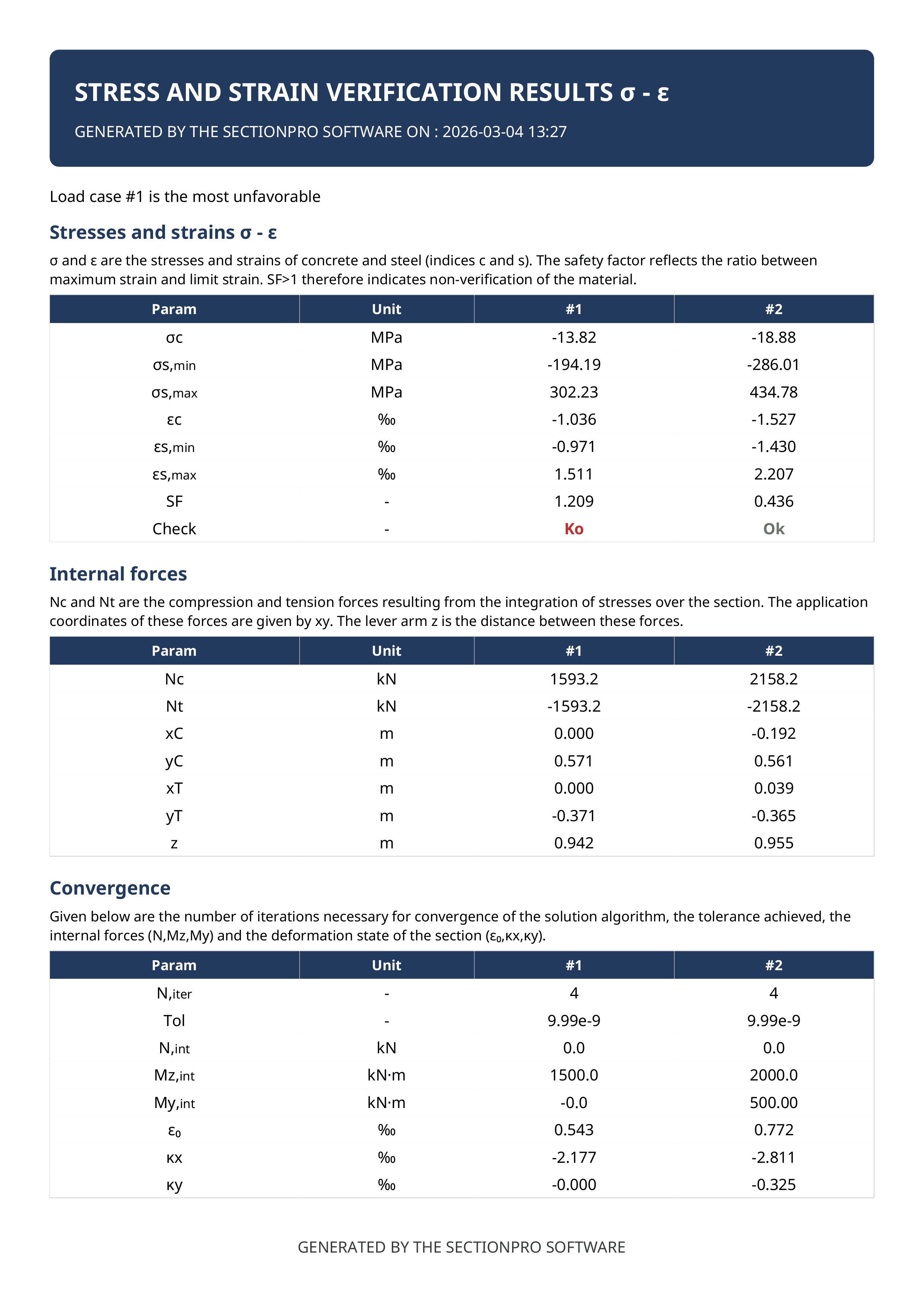
Given a set of imposed internal forces , SectionPro computes the strain state that satisfies internal equilibrium, using an iterative solver. From the converged strain state, the software extracts stresses and strains at the extreme fibers of concrete and reinforcement, internal compression and tension forces, and a factor of safety (FS) defined as the ratio of the critical strains to the allowable strain limits.
This article demonstrates the analysis on three geometries and three different standards — a solid hexagonal section (Eurocode 2), a hollow square section (NBR-6118), and a custom U-beam with inclined webs (BAEL 91) — each loaded at both the Serviceability Limit State (SLS, linear material laws) and the Ultimate Limit State (ULS, nonlinear material laws). The load cases are chosen so that some verifications pass (OK) and others fail (KO), showing the behavior of SectionPro when capacity is exceeded across different normative contexts.
Computed results
SectionPro reports three categories of results for each load case:
Stresses & strains
Internal forces
Convergence
Test scenarios
Each section is analyzed at both the Serviceability Limit State (SLS) and the Ultimate Limit State (ULS). In both cases, concrete has zero tensile strength (cracked section). At SLS, the material laws are linear-elastic. At ULS, the laws are nonlinear: concrete follows a parabola-rectangle law and steel follows a bilinear elasto-plastic law. A variety of load cases is introduced: some involve uniaxial combined bending (), others biaxial bending (). Some load cases remain within the section capacity (OK), while others deliberately exceed the allowable limits (KO).
| Section | SLS (linear) | ULS (nonlinear) | Biaxial? | Standard |
|---|---|---|---|---|
| Hexagonal | OK | KO | Yes (ULS) | EC2 |
| Hollow square | OK | OK | Yes | NBR-6118 |
| U-beam | KO | OK | Yes (ULS) | BAEL 91 |
Solid hexagonal section
Input data
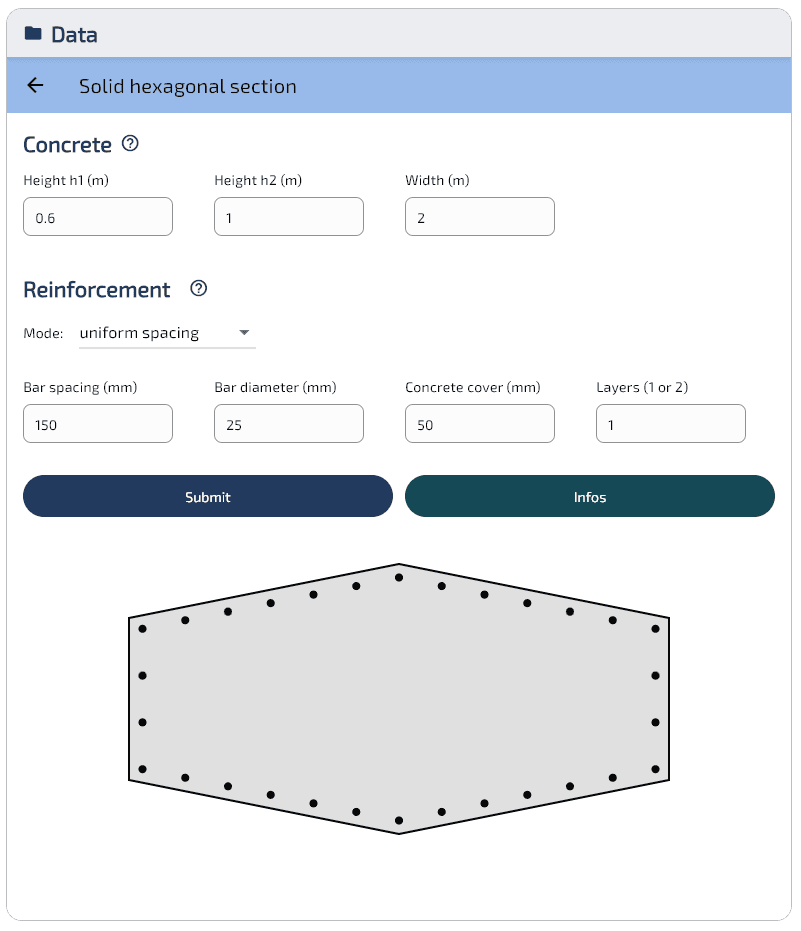
- Concrete — Hexagonal cross section, width m, minimum thickness m, maximum thickness m.
- Reinforcement — Uniform spacing 150 mm, 30 rebars, diameter 25 mm, cover 50 mm, 1 layer.
- Material laws (EC2) — Concrete C30/37: MPa, Steel B500B: MPa.
SLS — Combined bending (N + Mz)
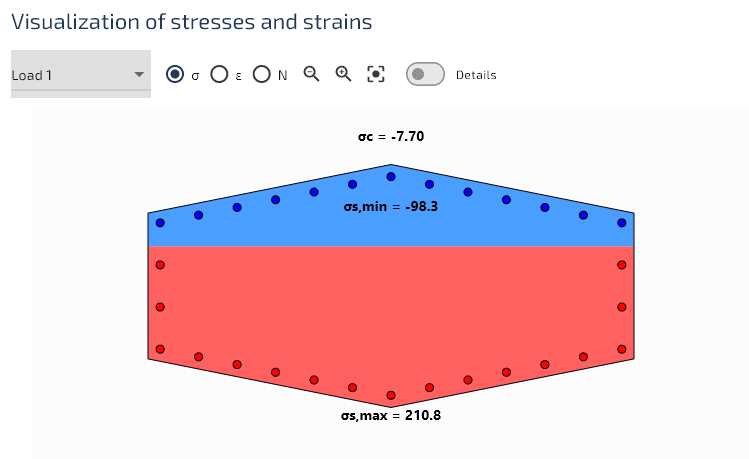
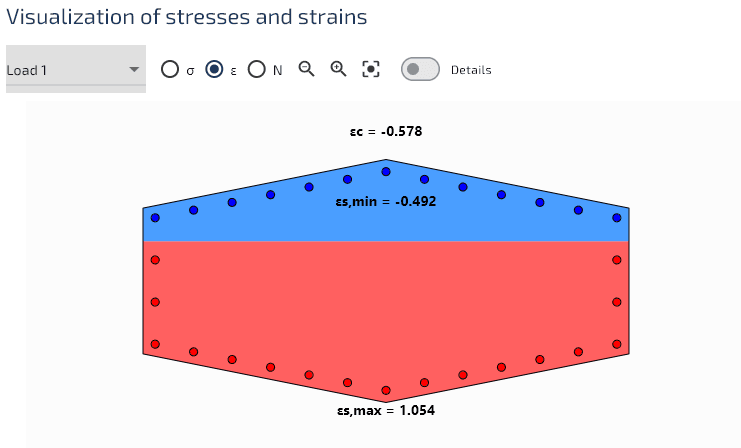
Imposed loads: kN, kN·m,
| Stresses & strains | Value |
|---|---|
| MPa | |
| MPa | |
| MPa | |
| ‰ | |
| ‰ | |
| ‰ | |
| FS | |
| Check | OK |
| Internal forces | Value |
|---|---|
| kN | |
| kN | |
| m | |
| m | |
| m | |
| m | |
| m |
| Convergence | Value |
|---|---|
| Tol | |
| kN | |
| kN·m | |
| kN·m | |
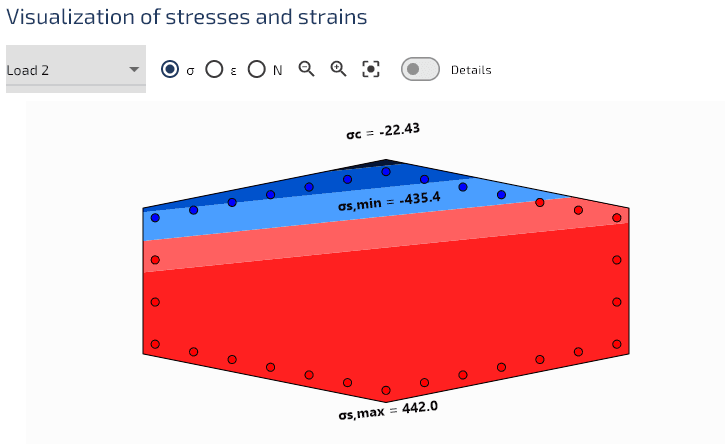
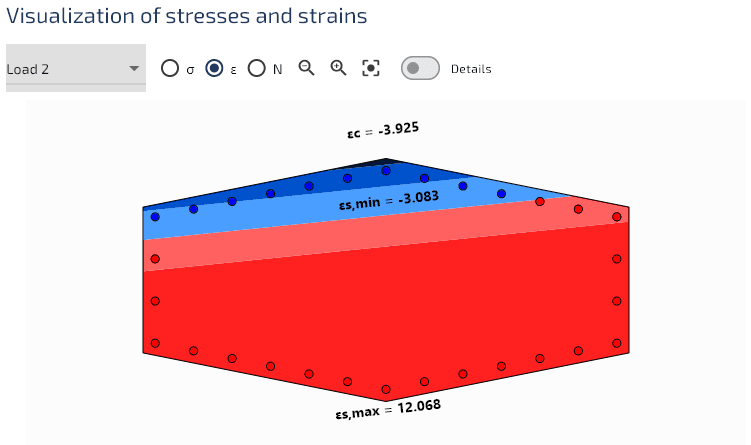
ULS — Biaxial bending (N + My + Mz)
Imposed loads: kN, kN·m, kN·m
| Stresses & strains | Value |
|---|---|
| MPa | |
| MPa | |
| MPa | |
| ‰ | |
| ‰ | |
| ‰ | |
| FS | |
| Check | KO |
| Internal forces | Value |
|---|---|
| kN | |
| kN | |
| m | |
| m | |
| m | |
| m | |
| m |
| Convergence | Value |
|---|---|
| Tol | |
| kN | |
| kN·m | |
| kN·m | |
Hollow square section
Input data
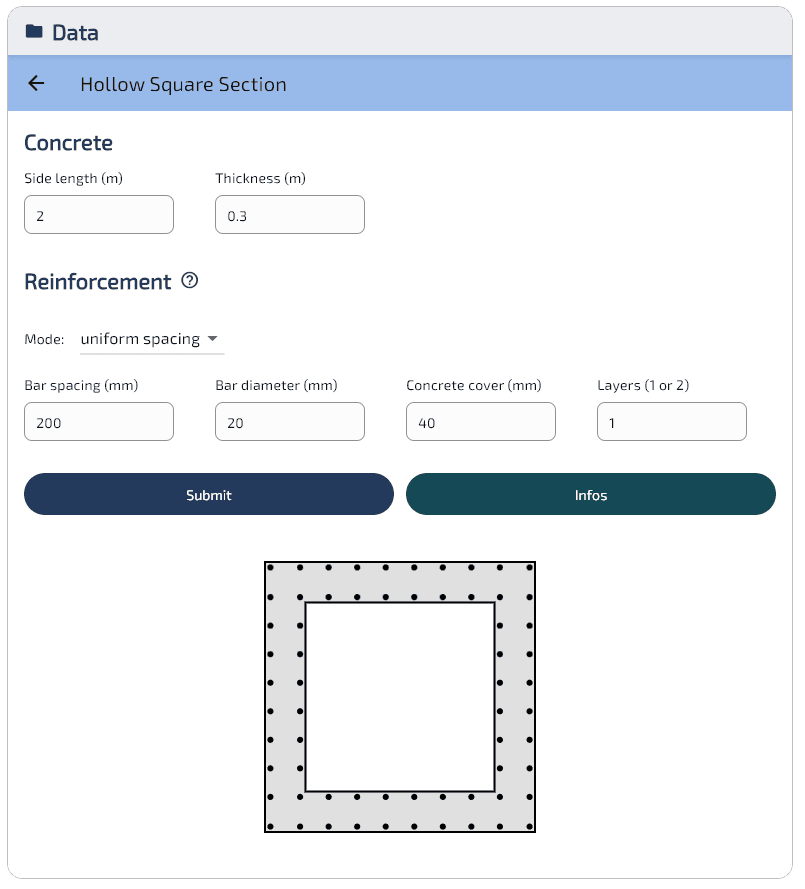
- Concrete — Hollow square section, outer side m, wall thickness m.
- Reinforcement — Uniform spacing 150 mm, 64 rebars, diameter 20 mm, cover 40 mm, 1 layer per face (inner + outer).
- Material laws (NBR-6118) — Concrete C30: MPa, Steel: MPa.
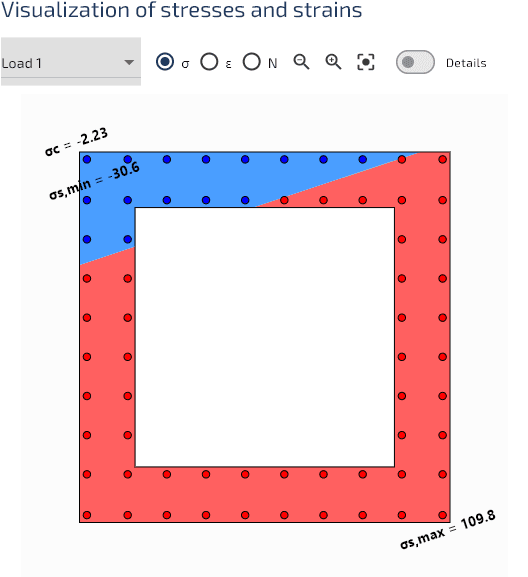
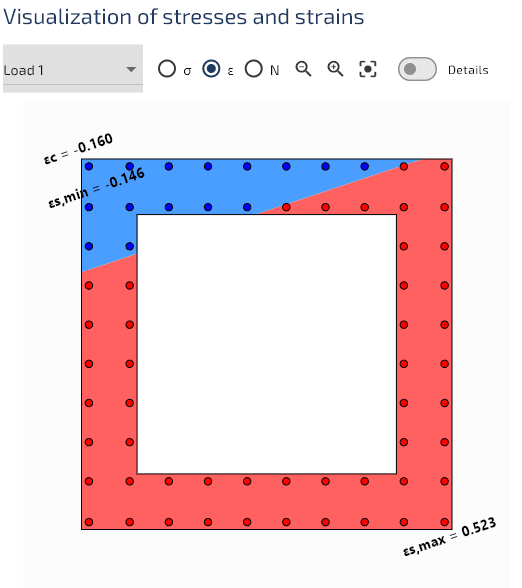
SLS — Biaxial bending (N + My + Mz)
Imposed loads: kN, kN·m, kN·m
| Stresses & strains | Value |
|---|---|
| MPa | |
| MPa | |
| MPa | |
| ‰ | |
| ‰ | |
| ‰ | |
| FS | |
| Check | OK |
| Internal forces | Value |
|---|---|
| kN | |
| kN | |
| m | |
| m | |
| m | |
| m | |
| m |
| Convergence | Value |
|---|---|
| Tol | |
| kN | |
| kN·m | |
| kN·m | |
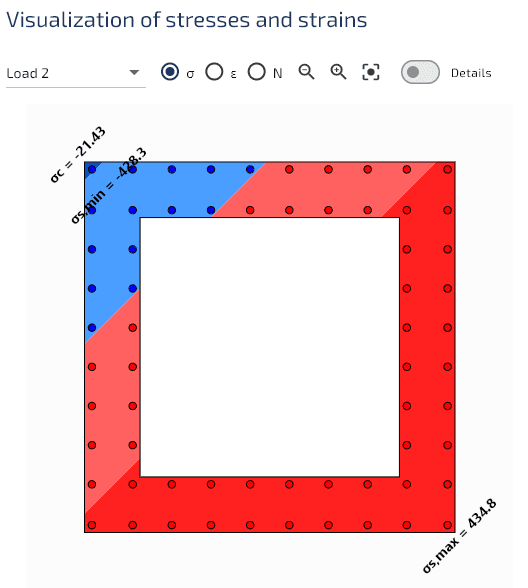
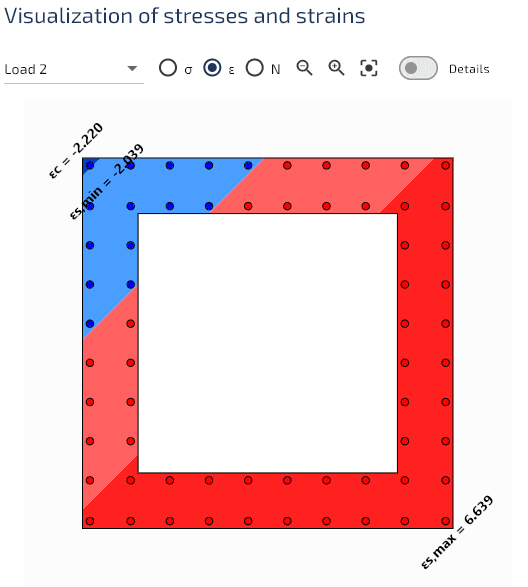
ULS — Biaxial bending (N + My + Mz)
Imposed loads: kN, kN·m, kN·m
| Stresses & strains | Value |
|---|---|
| MPa | |
| MPa | |
| MPa | |
| ‰ | |
| ‰ | |
| ‰ | |
| FS | |
| Check | OK |
| Internal forces | Value |
|---|---|
| kN | |
| kN | |
| m | |
| m | |
| m | |
| m | |
| m |
| Convergence | Value |
|---|---|
| Tol | |
| kN | |
| kN·m | |
| kN·m | |
Custom section — U-beam
Input data
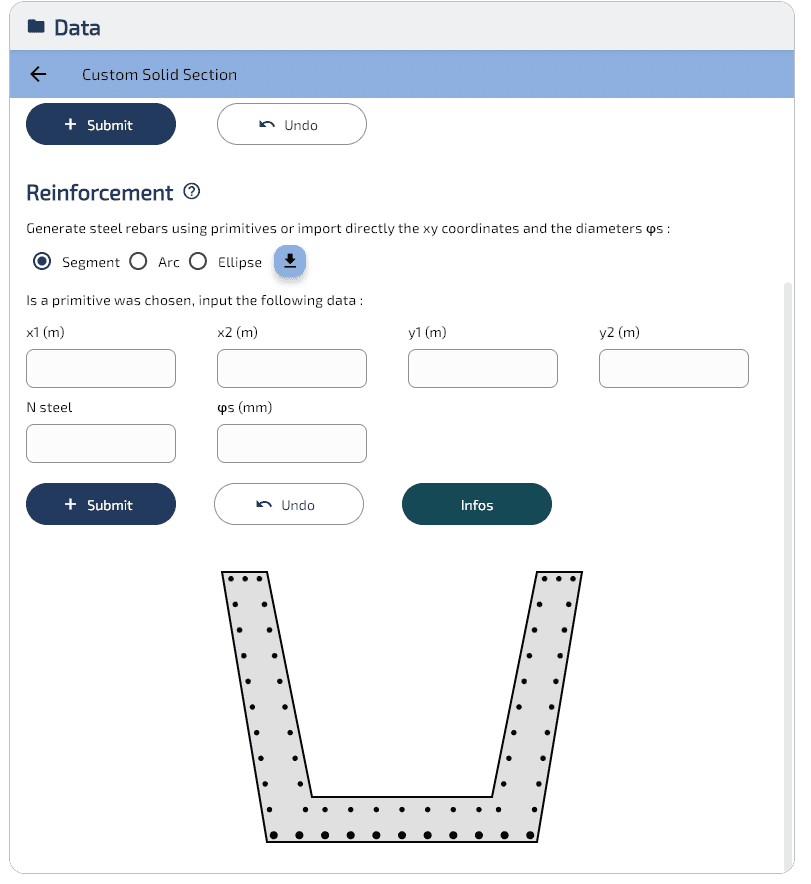
This section uses the custom solid geometry feature. The external contour is defined as a list of XY points, and the reinforcement layout is provided as a table of data (position and diameter of each bar). This is the recommended procedure for non-standard geometries that do not fit predefined parametric shapes.
- Concrete — U-beam with inclined webs, total height m.
- Reinforcement — Uniform spacing 150 mm, bottom slab: 11 rebars diameter 20 mm, webs: 49 rebars diameter 12 mm, 2 layers per web.
- Material laws (BAEL 91) — Concrete: MPa, , Steel fe500: MPa.
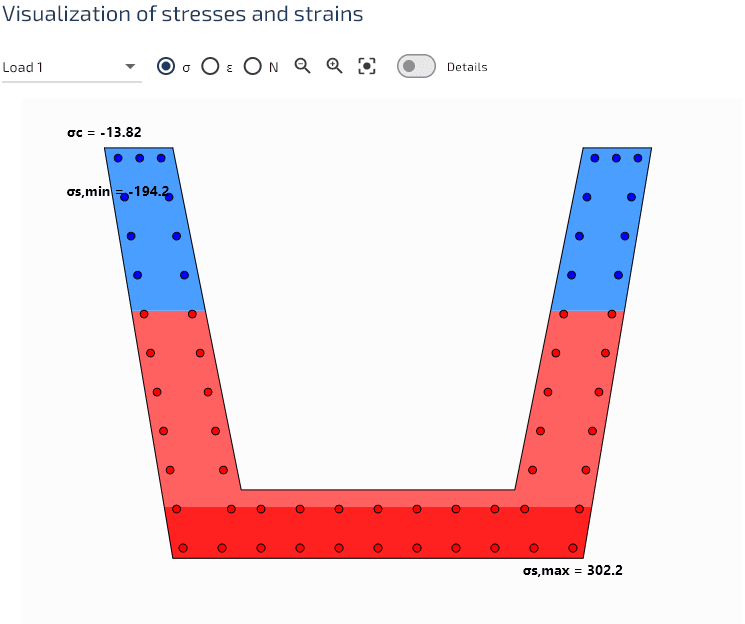
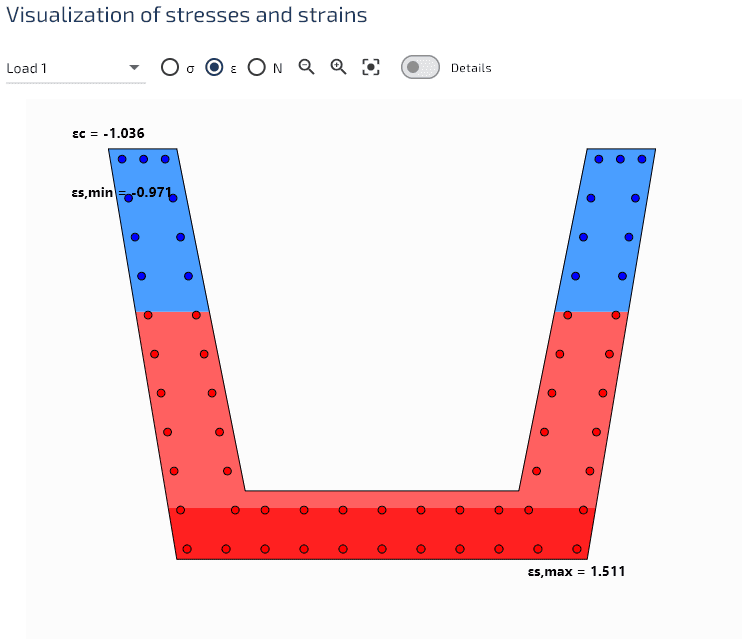
SLS — Pure bending (Mz)
Imposed loads: kN, kN·m,
| Stresses & strains | Value |
|---|---|
| MPa | |
| MPa | |
| MPa | |
| ‰ | |
| ‰ | |
| ‰ | |
| FS | |
| Check | KO |
| Internal forces | Value |
|---|---|
| kN | |
| kN | |
| m | |
| m | |
| m | |
| m | |
| m |
| Convergence | Value |
|---|---|
| Tol | |
| kN | |
| kN·m | |
| kN·m | |
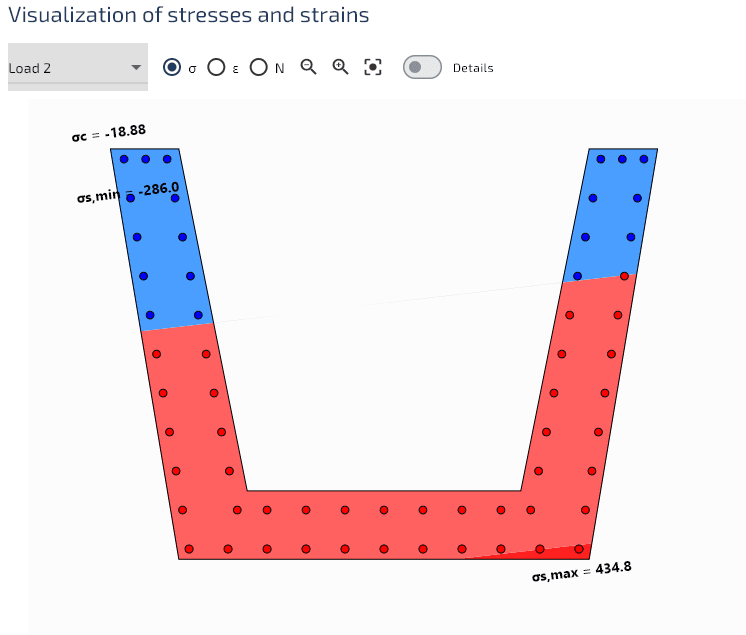
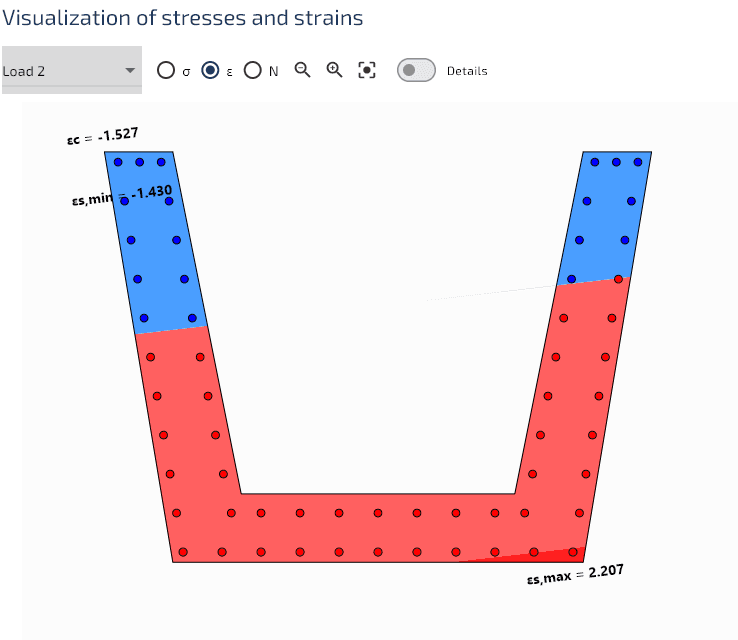
ULS — Biaxial bending (My + Mz)
Imposed loads: kN, kN·m, kN·m
| Stresses & strains | Value |
|---|---|
| MPa | |
| MPa | |
| MPa | |
| ‰ | |
| ‰ | |
| ‰ | |
| FS | |
| Check | OK |
| Internal forces | Value |
|---|---|
| kN | |
| kN | |
| m | |
| m | |
| m | |
| m | |
| m |
| Convergence | Value |
|---|---|
| Tol | |
| kN | |
| kN·m | |
| kN·m | |
Results validation
Internal equilibrium check
The imposed loads are the input. SectionPro finds the strain state by iterative solving, then integrates stresses over the section to obtain the internal forces . At convergence, these must match the imposed loads.
| Section | Load | (kN) | (kN) | (kN·m) | (kN·m) | Δ |
|---|---|---|---|---|---|---|
| Hexagonal | SLS | 0.00 % | ||||
| ULS | 0.00 % | |||||
| Hollow sq. | SLS | 0.00 % | ||||
| ULS | 0.00 % | |||||
| U-beam | SLS | 0.00 % | ||||
| ULS | 0.00 % |
Internal equilibrium is satisfied to machine precision for all six load cases — across three different geometries, three normative codes, and both linear (SLS) and nonlinear (ULS) material laws.
Performance benchmark — 100,000 load cases
To demonstrate SectionPro's suitability for envelope-based verifications, we run 100,000 load cases on each of the three sections defined above. The load cases combine SLS and ULS, linear and nonlinear material laws, uniaxial and biaxial bending, with a mix of OK and KO outcomes. The benchmark measures the pure computation time, excluding UI overhead. Convergence was obtained for all 300,000 load cases.
| Metric | Hexagonal | Hollow square | U-beam |
|---|---|---|---|
| Load cases | 100,000 | 100,000 | 100,000 |
| Computation time | 0.173 s | 0.304 s | 0.260 s |
| Rate | 578,000 loads/s | 329,000 loads/s | 385,000 loads/s |
All three sections complete in under 0.3 seconds — rates of 329,000 to 578,000 load cases per second. This makes SectionPro practical for systematic verifications of large load envelopes generated by finite element software, where thousands of load combinations must be checked in one go.
Export
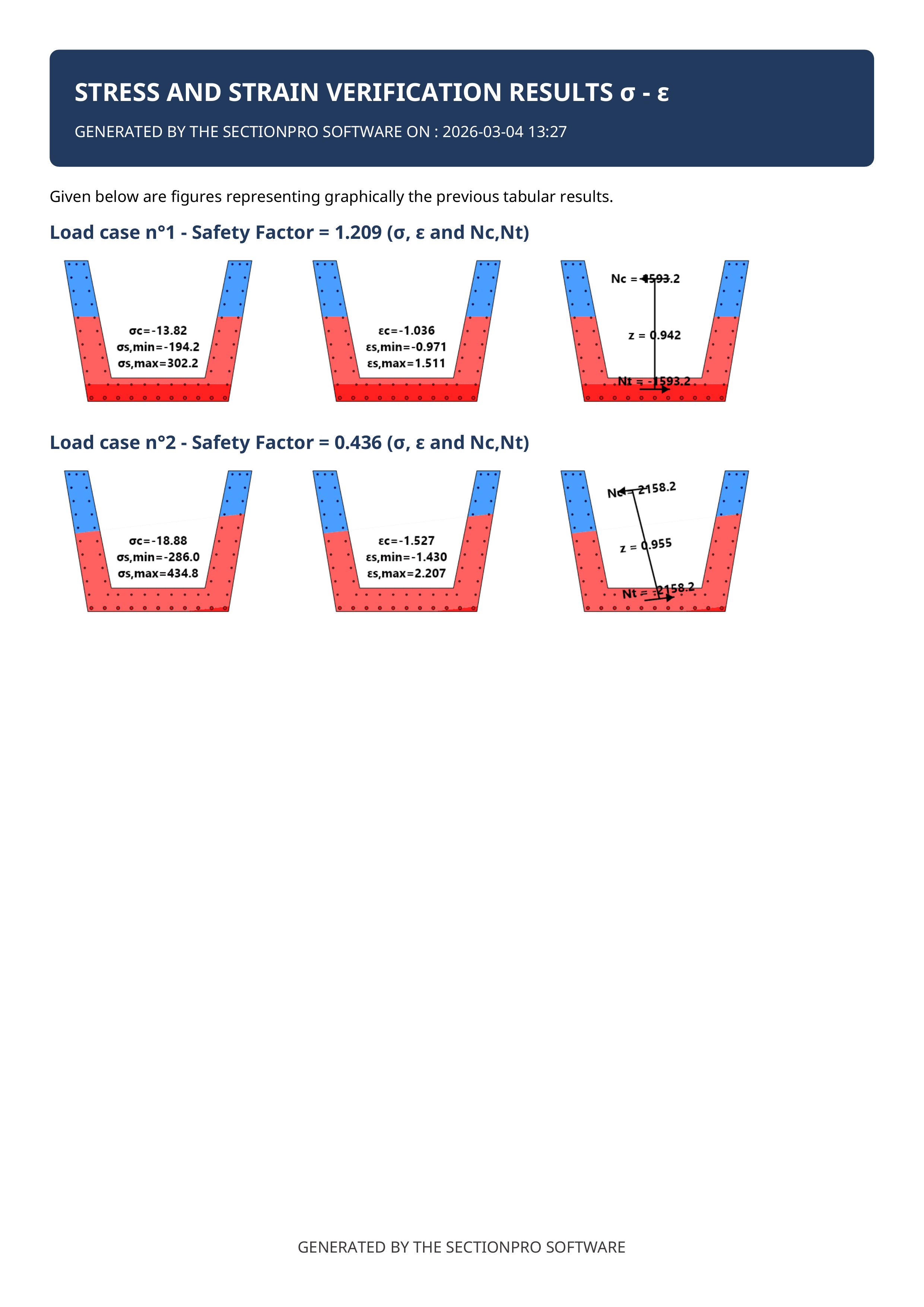
SectionPro exports results in three formats: PDF, text (fixed-width columns), and Excel (.xlsx). The exported data includes, per load case: stresses and strains, internal forces (with centroids and lever arm), full convergence information, and stress/strain distribution figures.
Conclusion
| Section | Load case | Standard | Check | Equilibrium Δ |
|---|---|---|---|---|
| Hexagonal | SLS (linear) | EC2 | OK | 0.00 % |
| ULS (nonlinear) | EC2 | KO | 0.00 % | |
| Hollow sq. | SLS (linear) | NBR-6118 | OK | 0.00 % |
| ULS (nonlinear) | NBR-6118 | OK | 0.00 % | |
| U-beam | SLS (linear) | BAEL 91 | KO | 0.00 % |
| ULS (nonlinear) | BAEL 91 | OK | 0.00 % |
The analysis correctly identifies the load cases that exceed the section capacity, with internal equilibrium satisfied to machine precision in all cases. The three sections span three different normative codes (EC2, NBR-6118, BAEL 91), different geometries (solid, hollow, custom), material laws (linear and nonlinear), and bending states (uniaxial and biaxial).
The 100,000-load benchmark shows computation times between 0.17 s and 0.30 s per section, corresponding to rates of 329,000 to 578,000 load cases per second, with convergence obtained for all 300,000 load cases. This makes SectionPro suitable for systematic verifications of load envelopes generated by finite element software.