

Introduction
Reinforced concrete is not a linear material: its flexural stiffness depends on the load level. At low loads, all materials remain in the elastic (steel) or initial tangent (concrete) range of their constitutive laws, so is high. As loading increases, the concrete enters the descending branch of its parabola-rectangle law and the steel reaches its yield plateau, causing to drop. This degradation matters for estimating realistic displacements, but also in statically indeterminate structures, second-order analysis, and redistribution problems.
SectionPro traces the full section response by fixing two force components and increasing the third (, , or ) from zero to failure. At each step, an iterative equilibrium is solved to find the strain state. Three curves are produced: force-deformation (-), secant stiffness , and tangent stiffness . The secant stiffness (slope from the origin to the current point) represents the average stiffness along the loading path, commonly used in iterative FEM analysis. The tangent stiffness (instantaneous slope) gives the exact stiffness for a given load state, used in nonlinear analysis where the stiffness matrix is updated at each step.
The solver also detects stiffness events: key transitions on the constitutive laws (elasticity to plasticity, and rupture). For steel, events can occur in both tension and compression; for concrete, in compression (plastic plateau at and crushing at ). Each event is reported with the participant, strain threshold, force level, and corresponding and .
Computed results
Curves
Events table
Exports
Rectangular section (Eurocode 2)
Input data
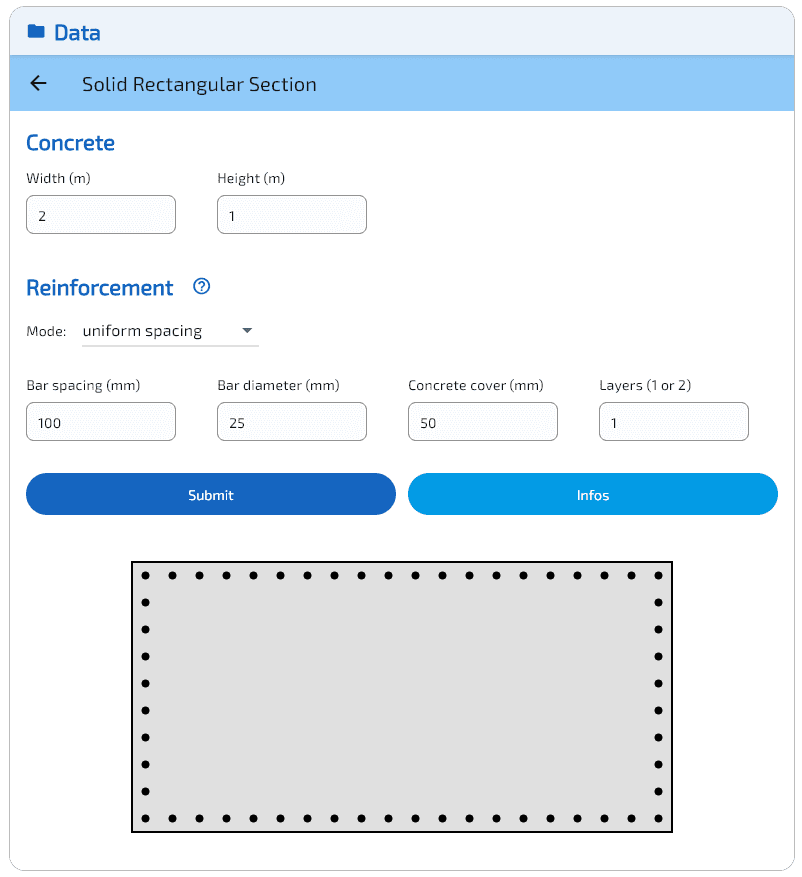
- Concrete — Solid rectangular cross section, width m, height m.
- Reinforcement — 56 bars, uniform spacing 100 mm, diameter mm, cover 50 mm, steel ratio .
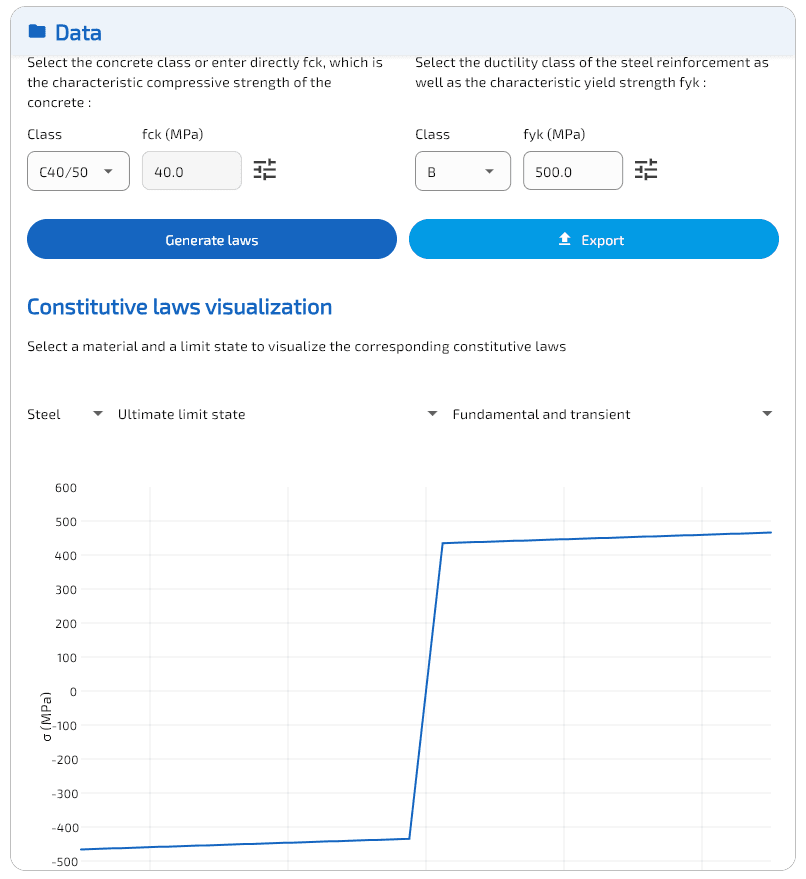
- Material laws (EC2) — Concrete C40/50: MPa, Steel B500B: MPa.
The stiffness curve is computed under pure bending: the free component is (curvature ) while and are held fixed. The limit state is ULS Fundamental (, ). The curvature is swept from zero to failure, and at each step the corresponding moment and stiffness are computed.
Moment-curvature and tangent stiffness
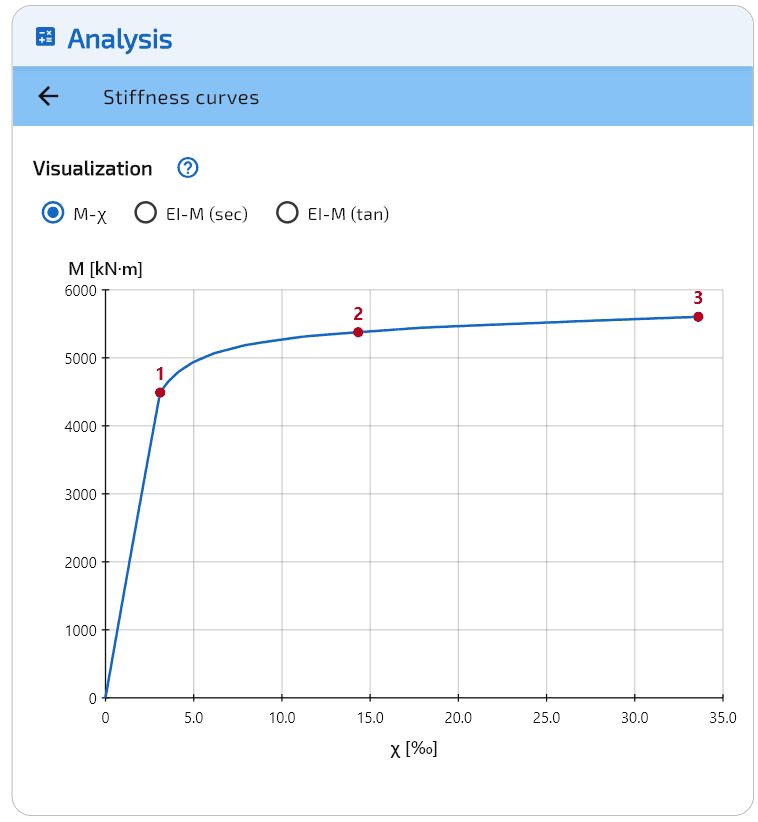
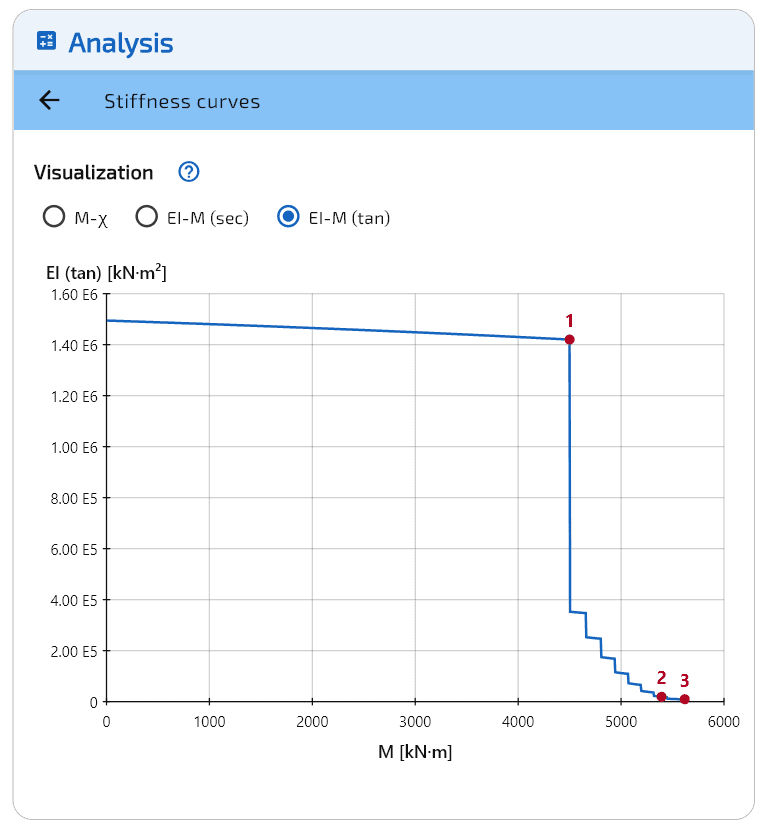
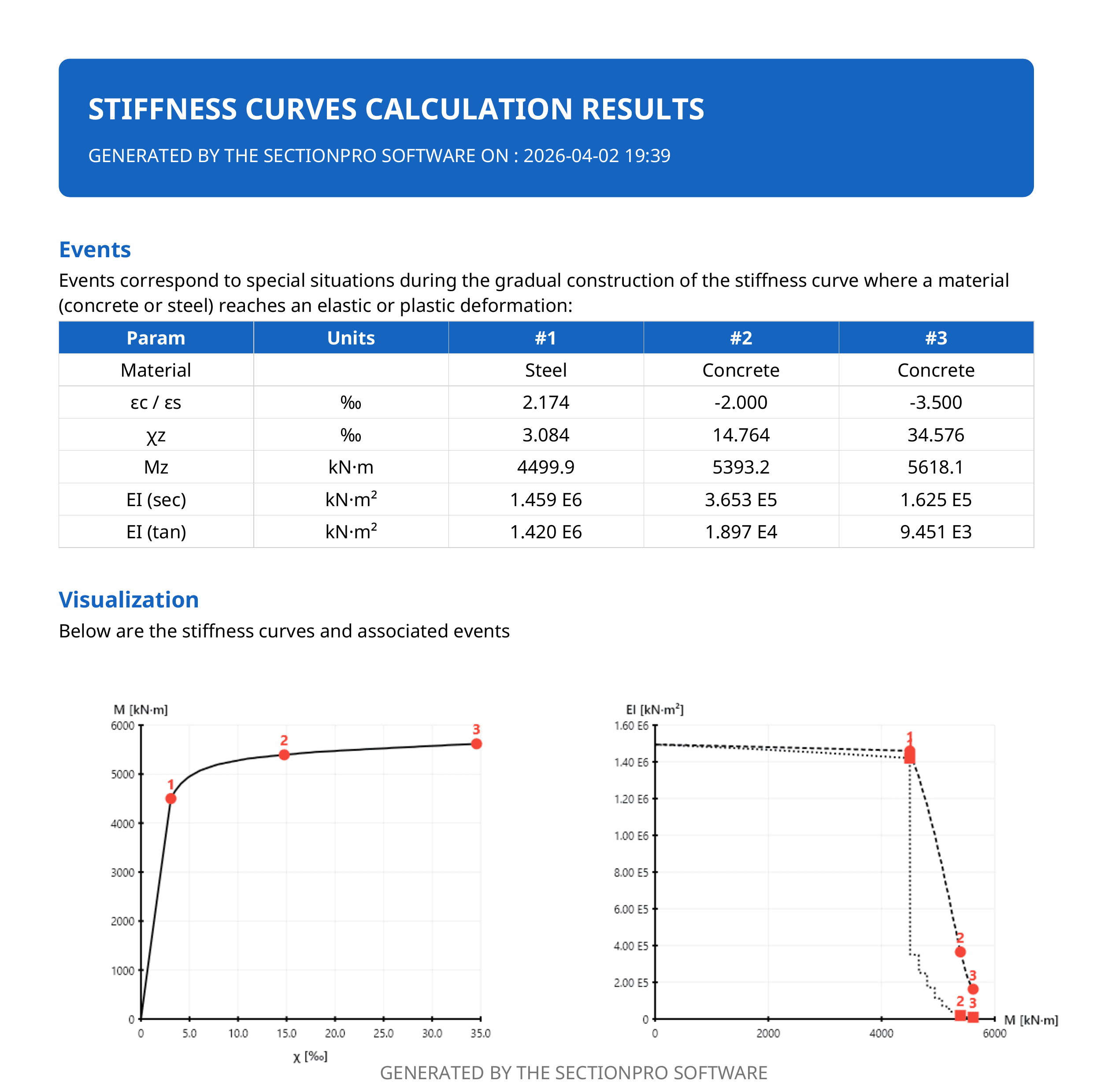
The - curve exhibits the classical shape: a steep initial branch where tangent moduli are high, a transition knee at event #1 (steel yielding), and a long plastic plateau where additional curvature produces little extra moment. The ultimate moment is only 25% above the yield moment, but the curvature has increased tenfold.
The tangent stiffness remains quasi-constant through the elastic range, then drops sharply at event #1. The drop is abrupt because all bars in the bottom layer share the same -coordinate and therefore yield simultaneously; this is the main flexural reinforcement, so its loss of stiffness has an immediate effect ( divided by 4 across this single event). Beyond event #2, falls to near zero, reflecting the almost flat plastic plateau on the - curve.
Secant stiffness and axial stiffness
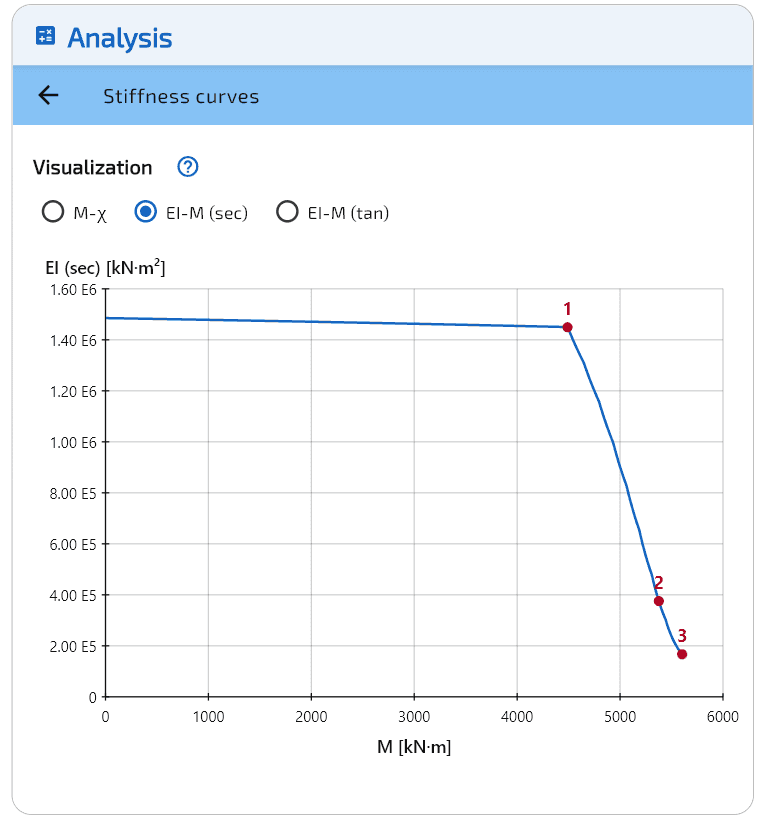
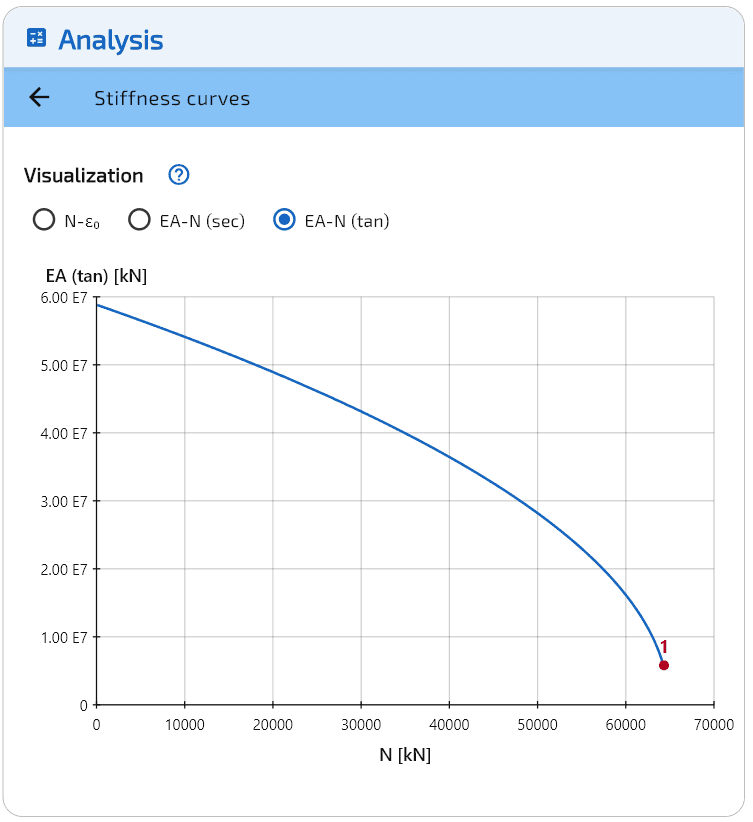
The secant stiffness remains nearly constant through the elastic range. The drop begins at event #1 (steel yielding), with only a 2% reduction at that point. The steep drop occurs between events #1 and #2, as the steel yields and the concrete enters its plastic plateau. At failure, only about 11% of the initial stiffness remains.
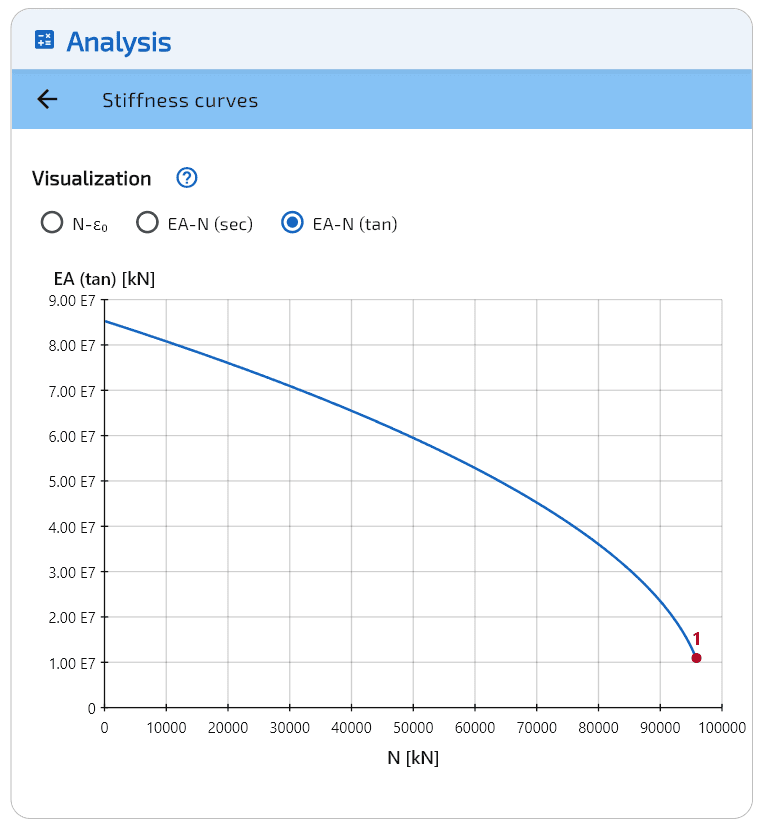
The axial stiffness follows a simpler pattern: it decreases as the tangent modulus of the concrete parabola-rectangle law decreases under increasing compressive strain. The curve terminates when the section reaches the ultimate compressive strain of the concrete.
Stiffness events
| # | Material | εc / εs (‰) | χz (‰) | Mz (kN·m) | EI sec (kN·m²) | EI tan (kN·m²) |
|---|---|---|---|---|---|---|
| 1 | Steel | 2.174 | 3.084 | 4 500 | 1.459E6 | 1.420E6 |
| 2 | Concrete | −2.000 | 14.764 | 5 393 | 3.653E5 | 1.897E4 |
| 3 | Concrete | −3.500 | 34.576 | 5 618 | 1.625E5 | 9.451E3 |
Event #1 is the onset of steel yielding ( ‰). Event #2 marks the concrete reaching its plastic plateau strain ‰. Event #3 is concrete crushing at ‰, which terminates the curve.
Hollow oblong section (BAEL 91)
Input data
- Concrete — Hollow oblong cross section, total width m, height m, rectangular width m, thickness m.
- Reinforcement — 108 bars, exterior spacing 200 mm, diameter mm, cover 50 mm, steel ratio .
- Material laws (BAEL 91) — Concrete: MPa, ; Steel: MPa, cracking P.
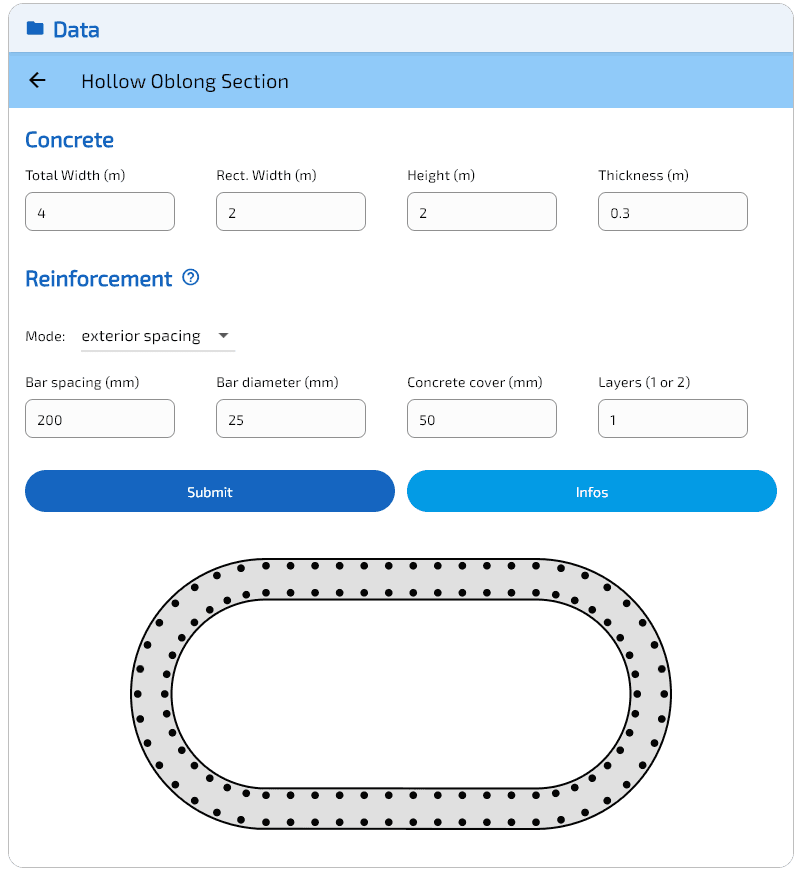
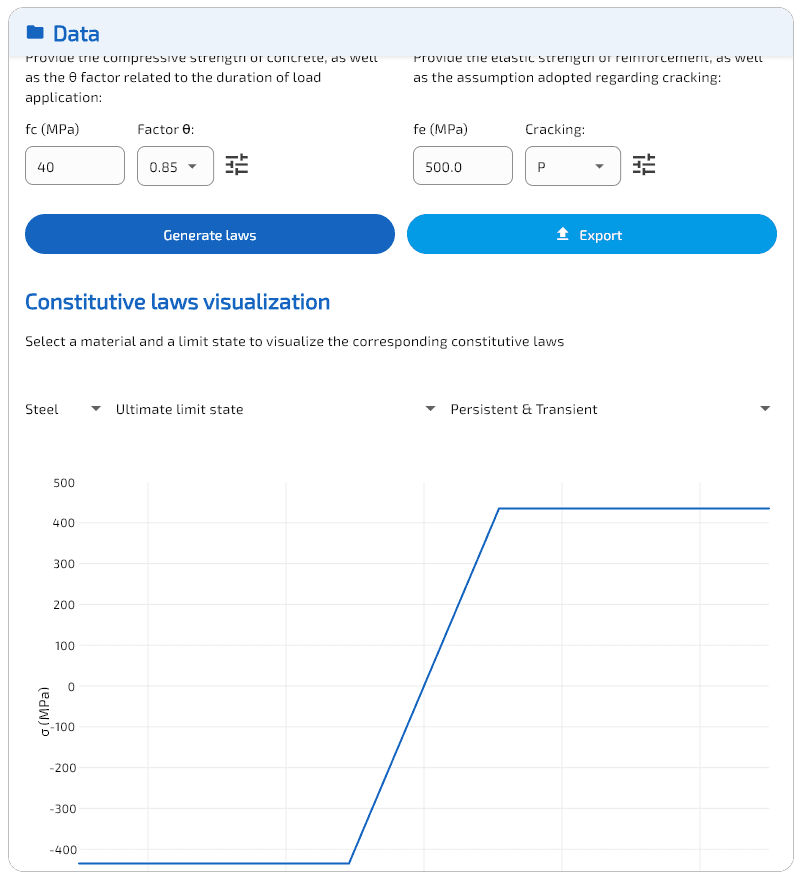
The stiffness curve is computed under pure bending about the strong axis: the free component is (curvature ) while and are held fixed. The limit state is ULS Persistent & Transient. This section is typical of bridge deck cross sections; the large inertia produces a high initial and the hollow core amplifies the stiffness drop after cracking.
Moment-curvature and tangent stiffness
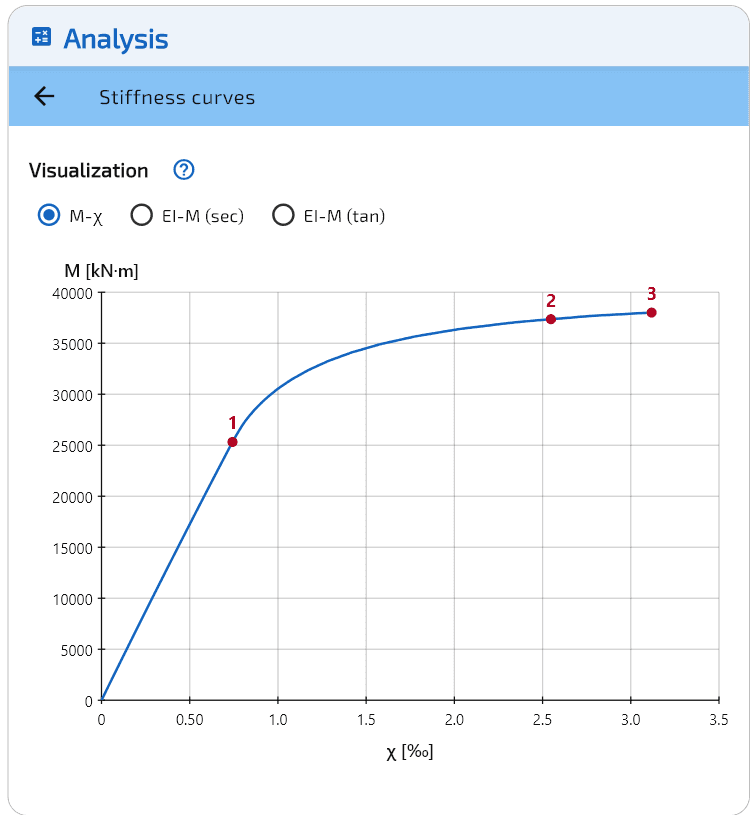
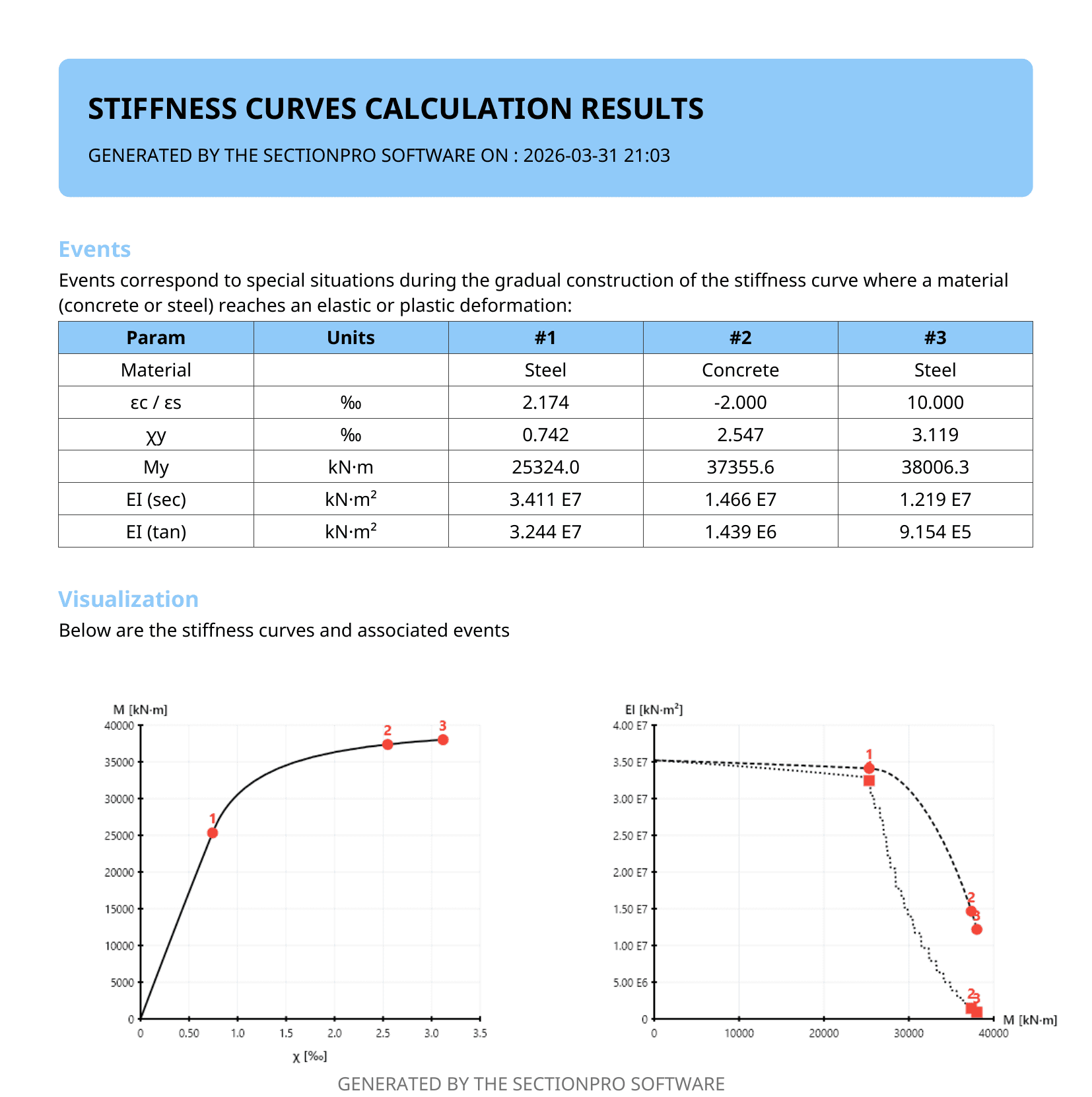
The - curve shows that the stiffness degradation begins at event #1 (steel yielding). The ultimate moment is 50% above the yield moment. The curve terminates by steel rupture (event #3) rather than concrete crushing — a different failure mode from the rectangular section. Not all events occur for all sections: the failure mode depends on the geometry, reinforcement layout, and material laws.
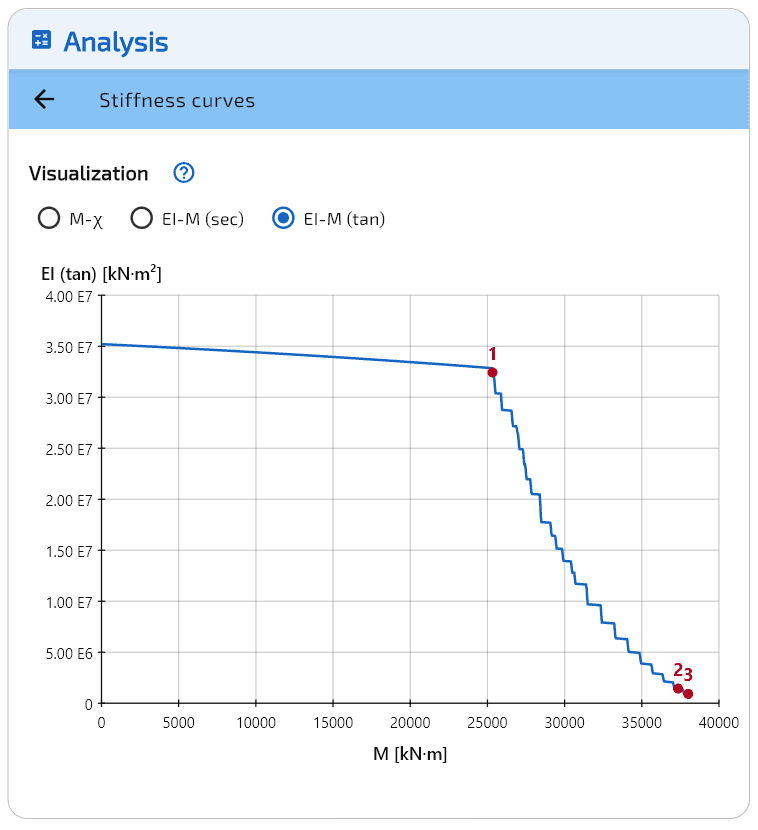
The tangent stiffness remains quasi-constant through the elastic range. The staircase pattern (more pronounced here than in the rectangular section) reflects the progressive yielding of individual reinforcement bars around the perimeter. After event #2, continues to drop, reaching two orders of magnitude below the initial value at failure.
Secant stiffness and axial stiffness
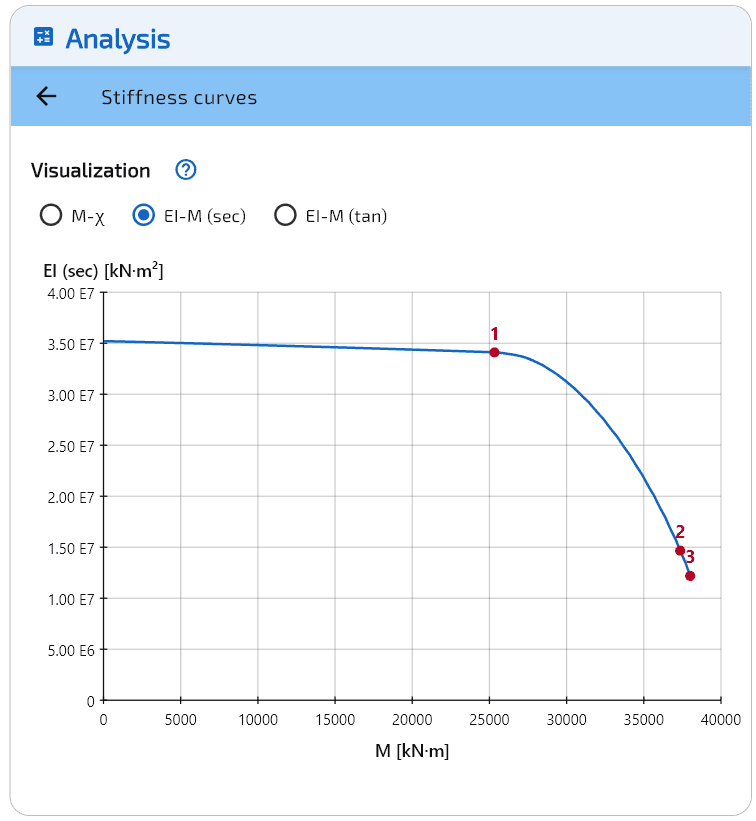
The secant stiffness degrades gradually: only a 3% drop at event #1. The curve steepens after event #2, and at failure about 35% of the initial stiffness remains. The smaller relative drop compared to the rectangular section (65% vs. 89%) is typical of hollow sections with high steel ratios.
Stiffness events
| # | Material | εc / εs (‰) | χy (‰) | My (kN·m) | EI sec (kN·m²) | EI tan (kN·m²) |
|---|---|---|---|---|---|---|
| 1 | Steel | 2.174 | 0.742 | 25 324 | 3.411E7 | 3.244E7 |
| 2 | Concrete | −2.000 | 2.547 | 37 356 | 1.466E7 | 1.439E6 |
| 3 | Steel | 10.000 | 3.119 | 38 006 | 1.219E7 | 9.154E5 |
Event #1 is the onset of steel yielding ( ‰). Event #2 marks the concrete reaching its plastic plateau ( ‰). Event #3 is steel rupture at ‰ (the design ultimate elongation under BAEL), which terminates the curve. Unlike the rectangular section where failure was governed by concrete crushing (), this section fails by steel rupture.
Performance benchmark
| Discretisation points | Rectangular EC2 (ms) | Oblong BAEL (ms) |
|---|---|---|
| 100 | 5.2 | 6.5 |
| 500 | 15.5 | 11.3 |
| 1 000 (default) | 17.3 | 19.5 |
| 5 000 | 61.0 | 60.9 |
The computation is essentially instantaneous regardless of the number of discretisation points: even at 5 000 points, both sections complete in under 61 ms.
Export
SectionPro exports the curve values in PDF, TXT and XLS formats for reuse in external tools. The PDF export also includes visualizations of the curves.
Conclusion
The stiffness curve module provides the true evolution of flexural and axial stiffness as a function of the loading state. By sweeping a force component from zero to failure, it captures the full degradation path — from the initial elastic response through progressive yielding to rupture — and reports the curvatures and axial strains at each load level.
The secant and tangent stiffnesses (, , ) give engineers the actual stiffness values to use in structural models, replacing the conventional assumption of constant . The automatically detected stiffness events identify the key transitions on the constitutive laws with their associated force levels and stiffness values.