

Introduction
SectionPro offers two verification workflows: the cross-section equilibrium solver (Article #3), which processes any number of load combinations and returns the detailed stress/strain state for each one individually; and the interaction-surface verification (Article #5), which builds the 3D resistance domain and evaluates all loads at once by measuring their normalized distance to the surface. Both answer the verification question: is the section adequate for a given ?
This article addresses the inverse problem, dimensioning: given a reinforcement layout and a set of load combinations, find the minimum bar diameter such that every load falls inside the interaction surface. The algorithm searches for the diameter that produces a surface where the most critical load arrives exactly at the boundary (), up to a numerical tolerance criterion. Each limit state is solved independently and SectionPro reports per state as well as the governing value across all states.
For ACI 318, CSA A23.3, and AASHTO, the surface is built natively from the Whitney stress block with strength reduction factors. Because loads are evaluated geometrically rather than by iterative convergence, this method becomes significantly faster for large load envelopes (see Section 5).
Computed results
SectionPro reports three categories of results:
Steel dimensioning
Distances & 3D view
Exports
Octagonal section (Eurocode 2)
Input data
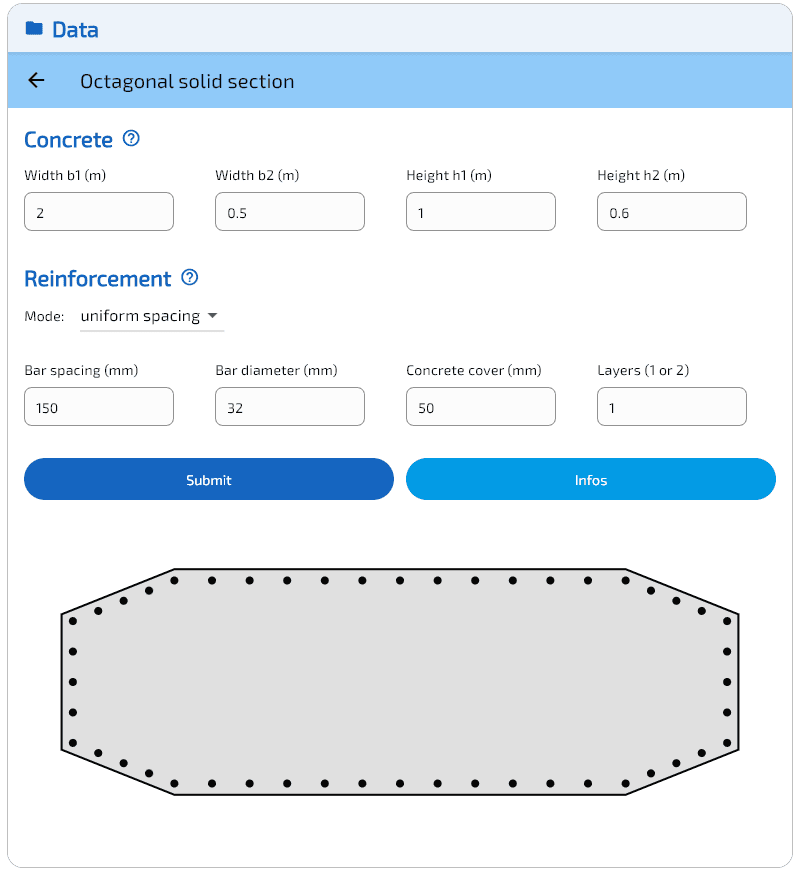
The section geometry, reinforcement layout, and material laws are identical to those used in Articles #4 and #5. 30 load combinations are defined: 15 at ULS-F (Fundamental) and 15 at SLS-C (Characteristic).
- Concrete — Octagonal cross section, m, m, m, m.
- Reinforcement layout — 48 bar positions, uniform spacing 150 mm, cover 50 mm, 1 layer, diameter : to be determined.
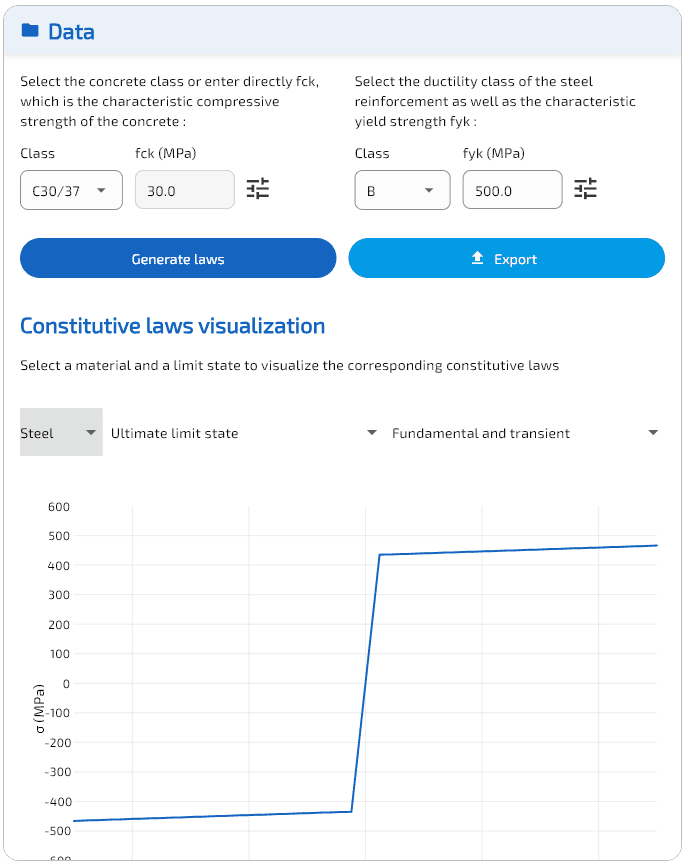
- Material laws (EC2) — Concrete C30/37: MPa, Steel B500B: MPa.
Dimensioning results
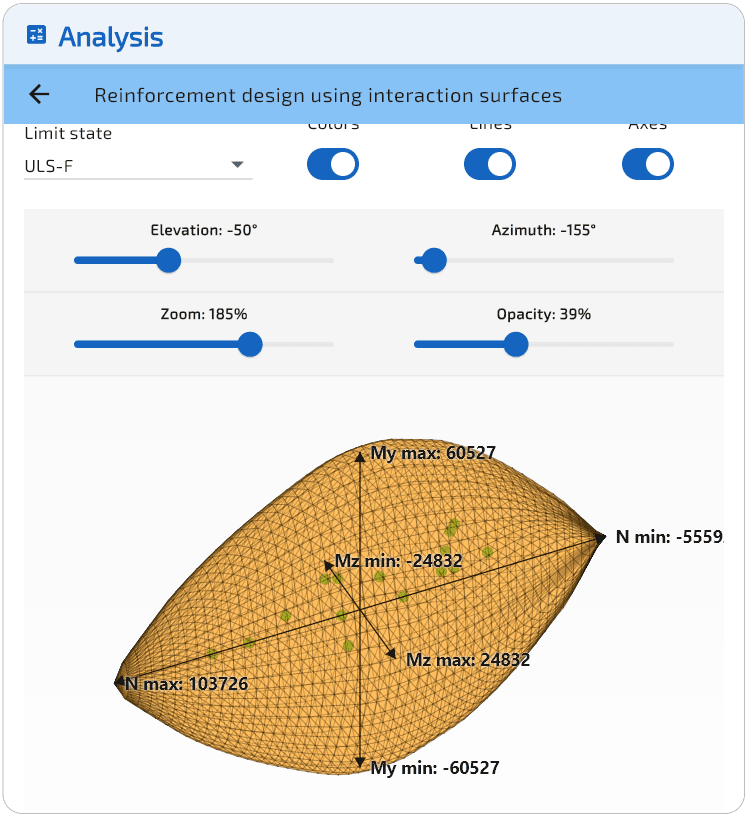
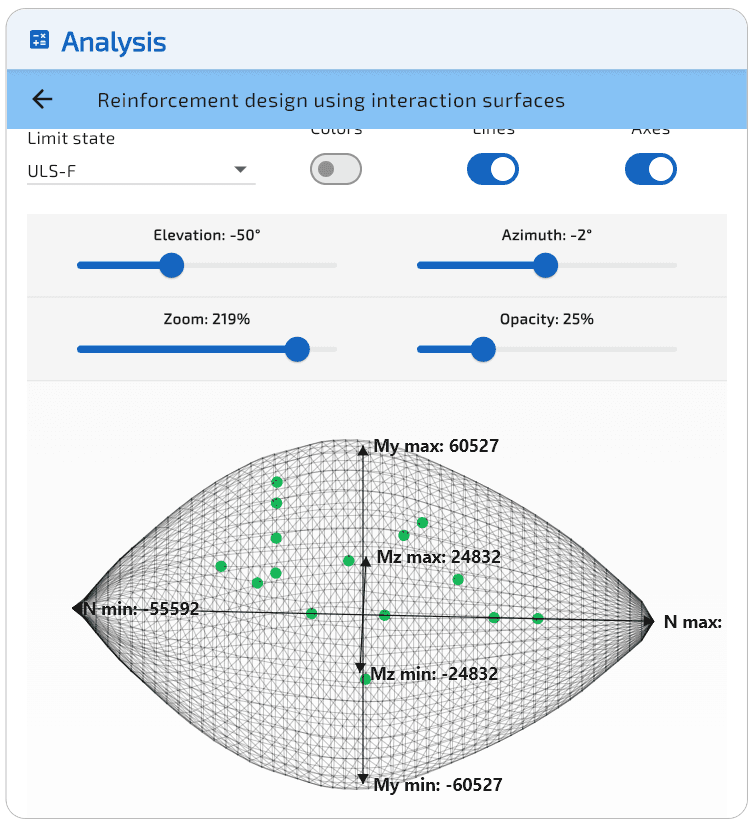
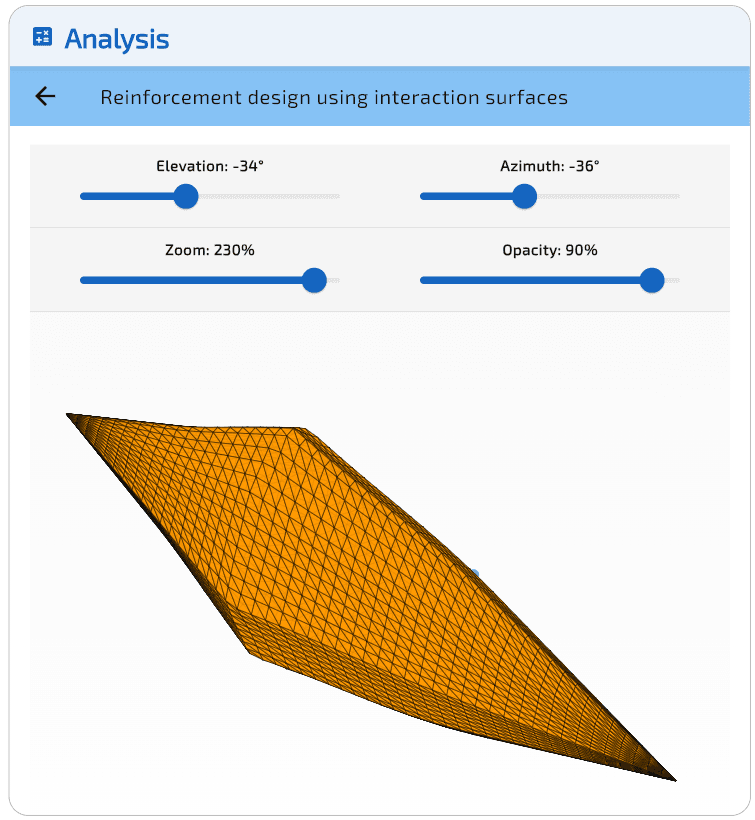
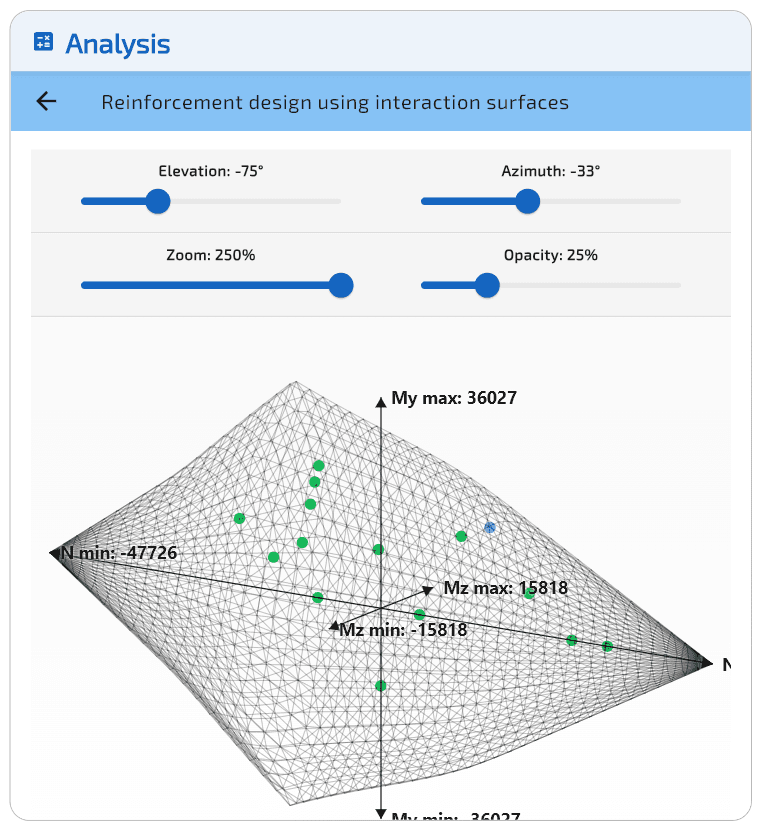
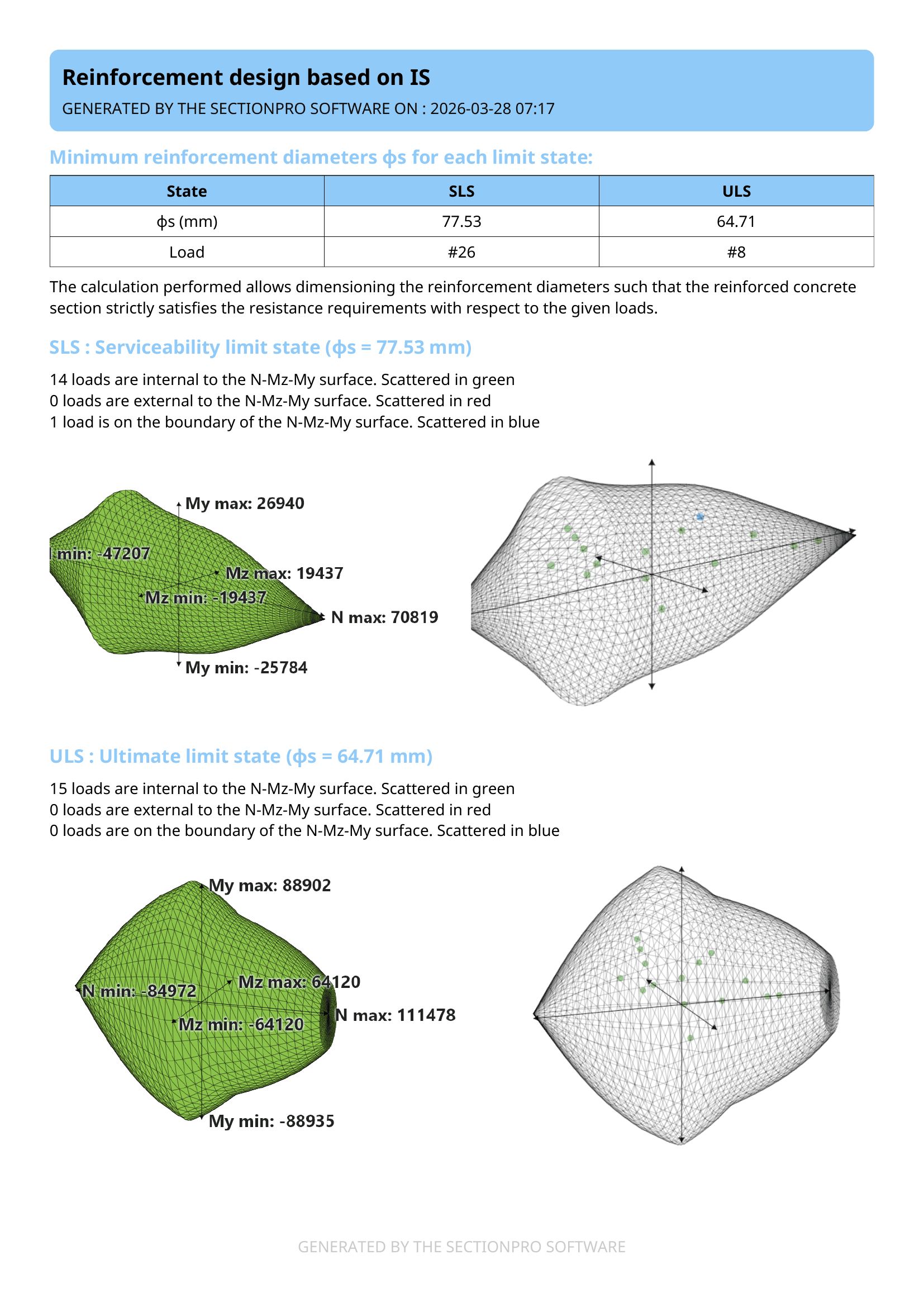
SLS-C governs with mm (vs 55.09 mm at ULS-F). At the governing diameter, the SLS-C boundary load (#26) is visible in blue on the surface, while all ULS-F loads are internal (green).
| State | (mm) | Worst load | Status | |
|---|---|---|---|---|
| ULS-F | #8 | Internal | ||
| SLS-C | #26 | Boundary |
Distances at the governing reinforcement
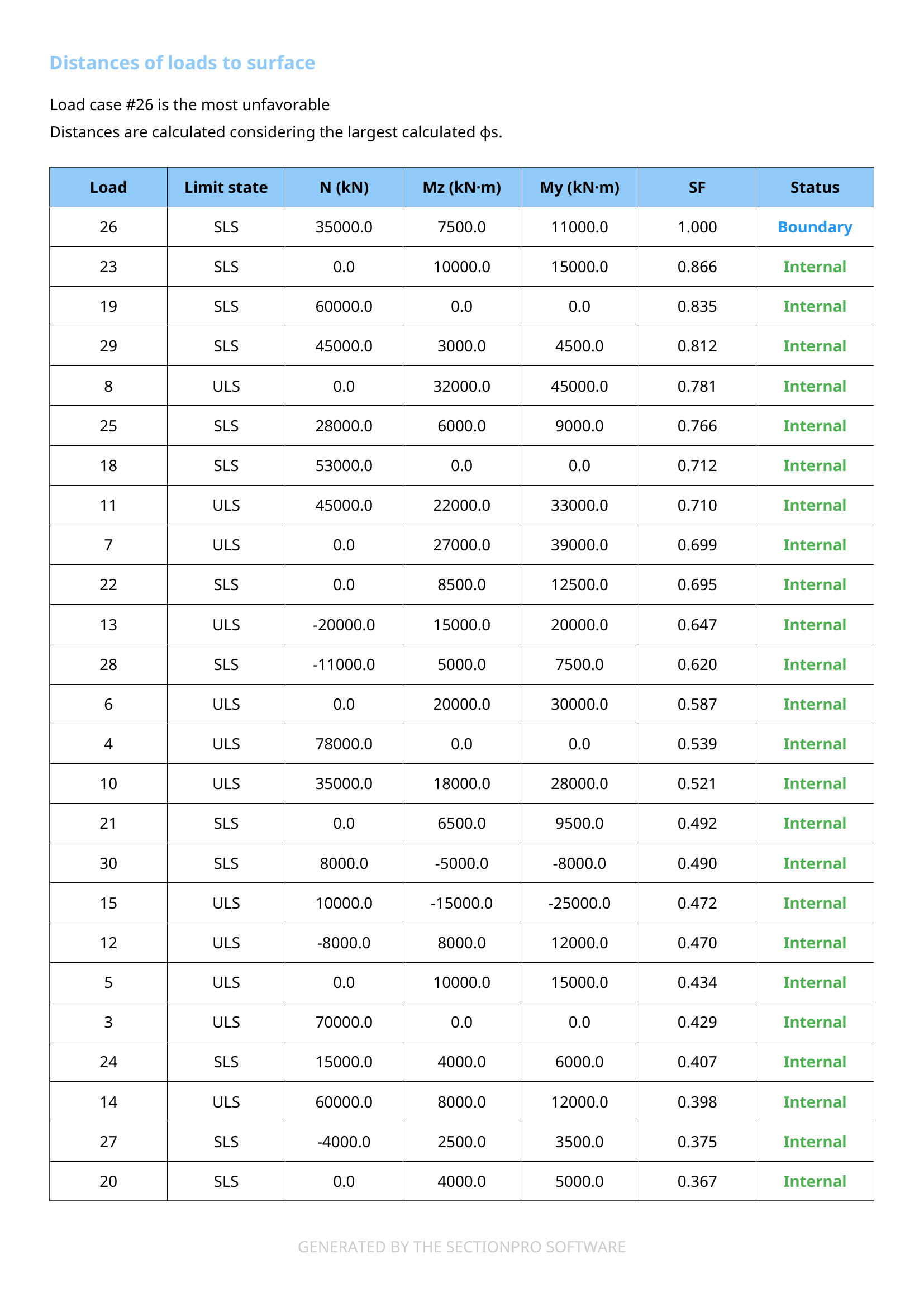
Once the governing mm is determined (SLS-C controls), SectionPro rebuilds the interaction surface for each limit state at this diameter and computes distances for all 30 loads. Every load must be Internal () or at the boundary ().
| Load | State | (kN) | (kN\cdotm) | (kN\cdotm) | Status | |
|---|---|---|---|---|---|---|
| 26 | SLS-C | Boundary | ||||
| 8 | ULS-F | Internal | ||||
| 23 | SLS-C | Internal | ||||
| 7 | ULS-F | Internal | ||||
| 25 | SLS-C | Internal | ||||
| 22 | SLS-C | Internal | ||||
| 28 | SLS-C | Internal | ||||
| 11 | ULS-F | Internal | ||||
| 29 | SLS-C | Internal | ||||
| 4 | ULS-F | Internal |
The remaining 20 loads all have . The full table can be exported by the software in PDF, TXT and XLS formats.
Elliptical section (ACI 318)
Input data
The section geometry, reinforcement, and material laws are identical to those used in the interaction-surface verification article. 30 load combinations are defined: 15 at ULS and 15 at SLS. The ACI 318 Whitney stress block is used natively to build the ULS interaction surface, including the strength reduction factors ( tension-controlled, compression-controlled, cap). The SLS surface uses linear elastic behaviour with allowable stresses ( MPa, MPa).
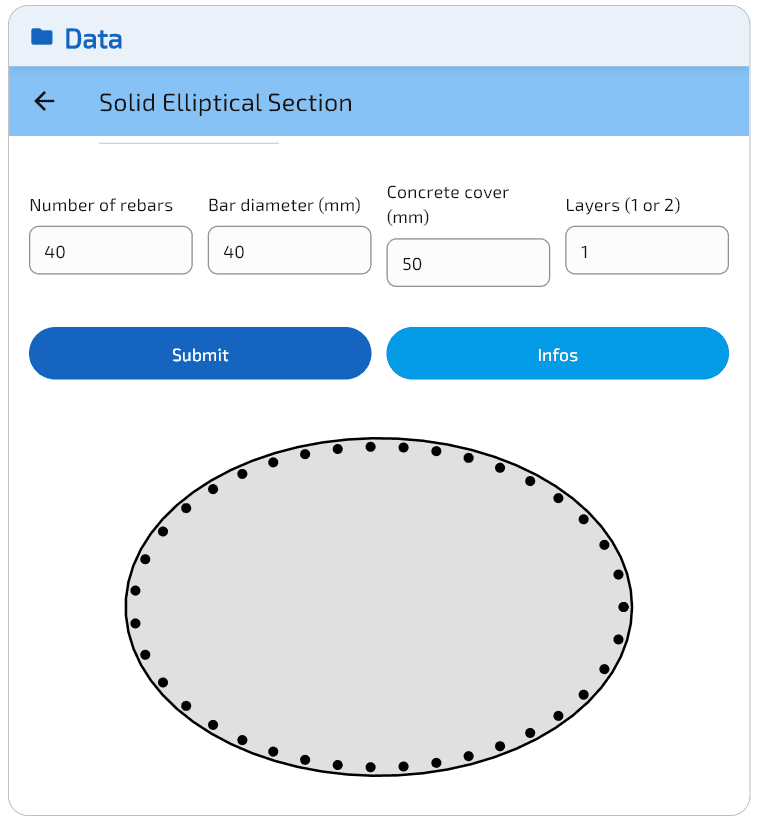
- Concrete — Elliptical cross section, width m, height m.
- Reinforcement layout — 40 bars along the perimeter, cover 50 mm, diameter : to be determined.
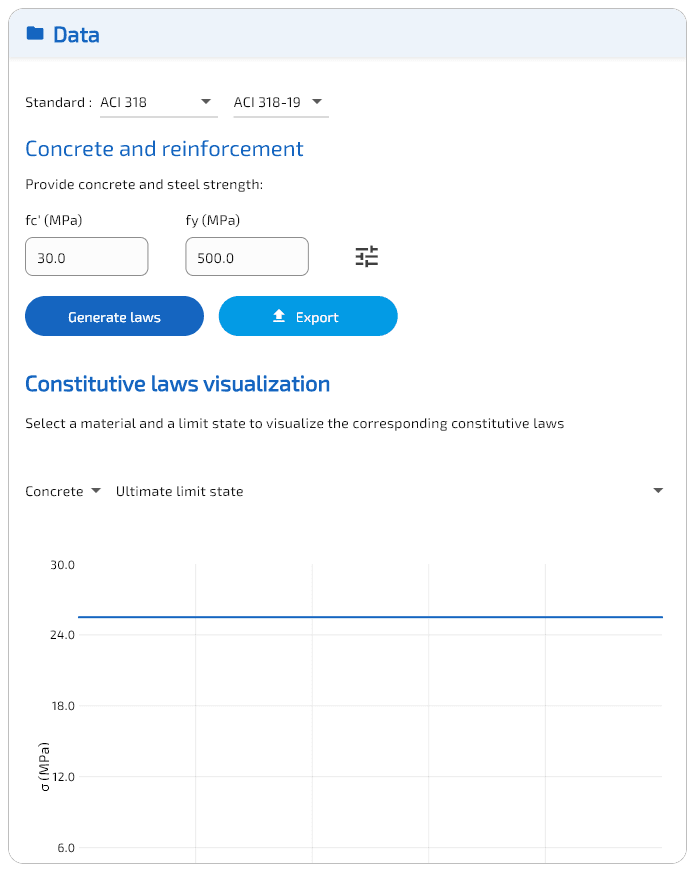
- Material laws (ACI 318) — Concrete: MPa, Steel: MPa, Whitney block: .
Dimensioning results
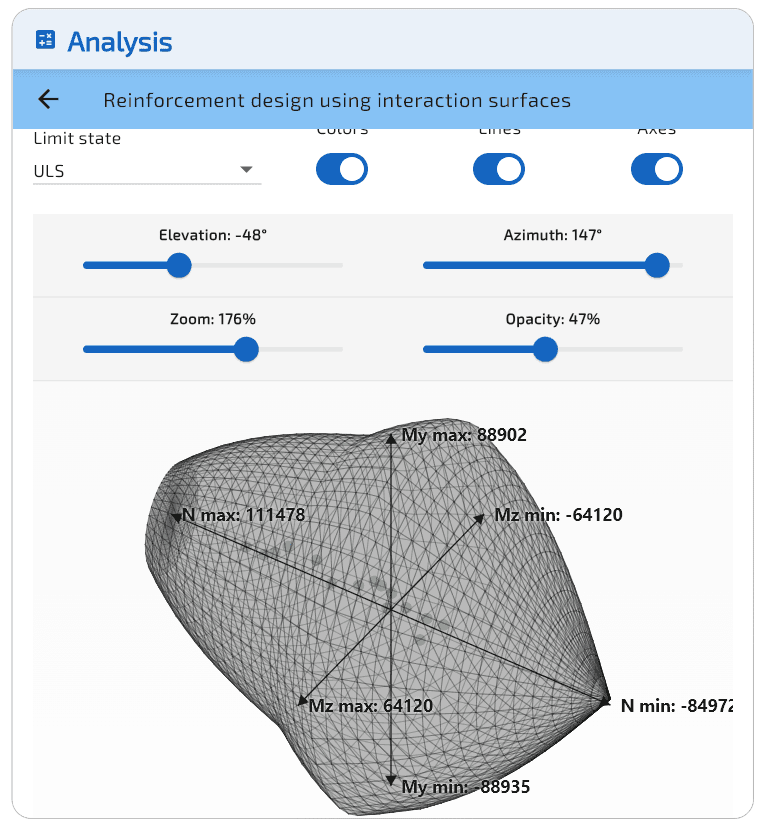
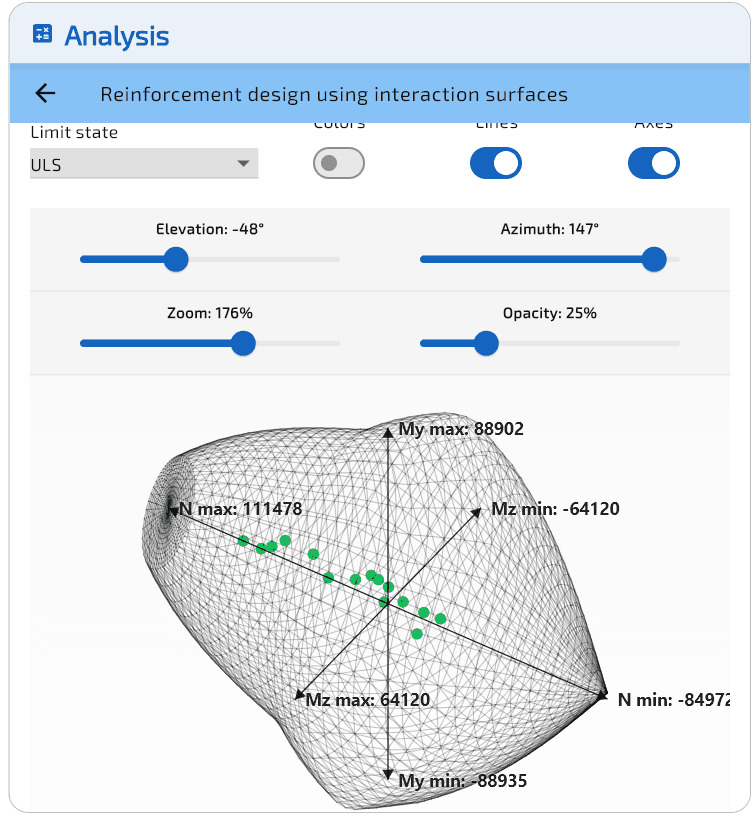
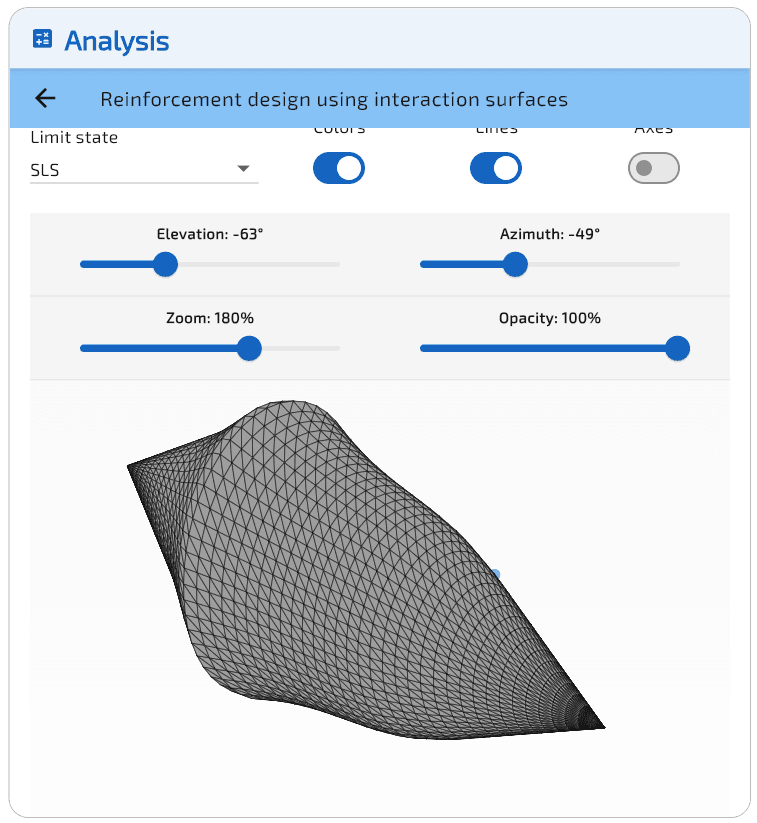
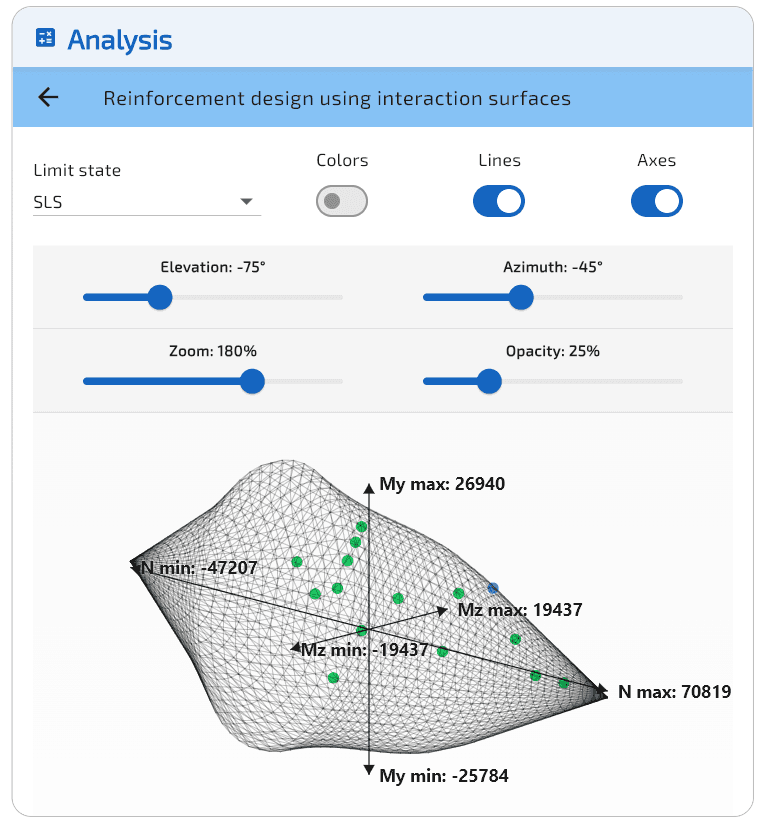
SLS governs with mm (vs 64.71 mm at ULS). The SLS boundary load (#26) is visible in blue on the surface, while all ULS loads are internal (green).
| State | (mm) | Worst load | Status | |
|---|---|---|---|---|
| ULS | #8 | Internal | ||
| SLS | #26 | Boundary |
Distances at the governing reinforcement
At the governing mm (SLS controls), all 30 loads are Internal. The top 10 most critical loads are:
| Load | State | (kN) | (kN\cdotm) | (kN\cdotm) | Status | |
|---|---|---|---|---|---|---|
| 26 | SLS | Boundary | ||||
| 23 | SLS | Internal | ||||
| 19 | SLS | Internal | ||||
| 29 | SLS | Internal | ||||
| 8 | ULS | Internal | ||||
| 25 | SLS | Internal | ||||
| 18 | SLS | Internal | ||||
| 11 | ULS | Internal | ||||
| 7 | ULS | Internal | ||||
| 22 | SLS | Internal |
Cross-validation with interaction-surface verification (Article #5)
The interaction-surface verification (Article #5) analysed the same two sections with fixed bar diameters ( mm for the octagon, mm for the ellipse). At those diameters, several loads were classified as External (), meaning the section capacity was exceeded. The dimensioning module (this article) must therefore return values larger than those fixed diameters.
Octagonal section (EC2, fixed diameter = 32 mm in Art. #5)
With mm, 7 of the 15 ULS-F loads were External and 8 of the 15 SLS-C loads were External. The dimensioning module returns mm (ULS-F) and mm (SLS-C), both well above 32 mm, confirming that the fixed diameter was insufficient. The governing SLS-C diameter is 76% larger than the verification diameter.
| Limit state | Art.#5 (mm) | dim. (mm) | External in Art.#5 |
|---|---|---|---|
| ULS-F | 7 / 15 | ||
| SLS-C | 8 / 15 |
Elliptical section (ACI 318, fixed diameter = 40 mm in Art. #5)
Similarly, with mm, 7 of the 15 ULS loads and 8 of the 15 SLS loads were External. The dimensioning module returns mm (ULS) and mm (SLS). The governing SLS diameter is 94% larger than the verification diameter.
| Limit state | Art.#5 (mm) | dim. (mm) | External in Art.#5 |
|---|---|---|---|
| ULS | 7 / 15 | ||
| SLS | 8 / 15 |
In both cases, the dimensioning module correctly returns diameters that exceed the verification diameter whenever external loads were present, confirming full consistency between the verification and dimensioning workflows.
Cross-validation with cross-section equilibrium solver (Article #3)
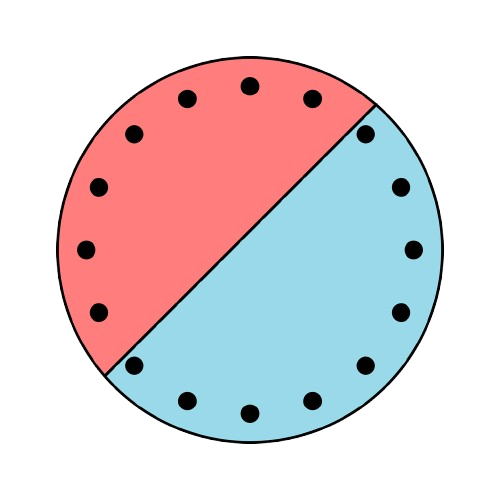
The cross-section equilibrium solver (Article #3) computed the required for individual load cases on a solid hexagonal section (EC2, C30/37, 30 bars, 150 mm spacing). Two load cases at ULS-F were analysed: a combined biaxial loading and a uniaxial bending case. Running the dimensioning module on the same section with these two loads as the envelope, the governing must match the largest diameter found by the direct solver.
Hexagonal section -- two-load envelope
| Load | (kN) | (kN\cdotm) | (kN\cdotm) | (mm) | (mm) |
|---|---|---|---|---|---|
| ULS | -- | ||||
| SLS | -- | ||||
| Gov. | 10.73 | 10.82 |
Both solvers converge to the same governing diameter: mm (equilibrium) vs mm (interaction surface).
Performance benchmark
The following table compares the computation time on the octagonal EC2 section (5 limit states, 48 bars), scaling the number of load combinations from 2 to 1,000,000. Loads are distributed randomly across all limit states. The equilibrium solver performs one iterative convergence per load. The interaction-surface method builds the surface and evaluates all loads geometrically.
| Loads | Direct solver (ms) | SI dimensioning (ms) | Speedup |
|---|---|---|---|
Both methods deliver similar performance across all scales, with the equilibrium solver faster at small envelopes and the interaction-surface method catching up around loads. The values agree to within 0.1% at all scales. The practical advantage of the interaction-surface approach is not raw speed but the visual output: the 3D scatter plot on the governing surface gives immediate confirmation that all loads are enclosed, which the equilibrium solver does not provide.
Conclusion
- One run, all loads: the algorithm processes any number of load combinations in a single pass.
- Whitney-native for US codes: for ACI 318, CSA A23.3, and AASHTO, the surface is built directly from the Whitney stress block with strength reduction factors.
- Cross-validated: the dimensioning results match the interaction-surface verification (Article #5: loads that were External at the fixed diameter now require a larger ) and the cross-section equilibrium solver (Article #3: both methods converge to the same governing diameter within numerical tolerance).
- Visual confirmation: the 3D scatter plot at the governing immediately shows that all loads are enclosed, with the critical load at the boundary.
- Complementary to the equilibrium solver: the equilibrium solver returns the full stress/strain state, while the interaction-surface method provides a visual envelope check at similar computational cost.
Export
SectionPro exports the dimensioning results in PDF, TXT and XLS formats. The PDF report includes 3D views of the final interaction surface with scattered load points and a results table.