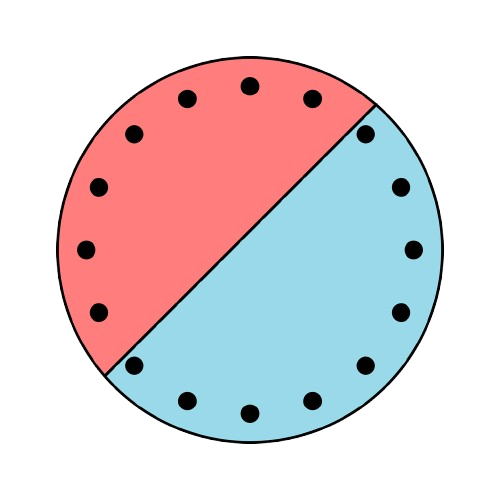


Introduction
Given a set of imposed internal forces and a predefined reinforcement layout (bar positions and spacing), SectionPro determines the minimum bar diameter required to satisfy the normative limits at each bar location. This is the inverse problem of the stress verification analysis (Article #2): instead of checking whether a given reinforcement is sufficient, the software finds the reinforcement that achieves equilibrium under the imposed loads.
The solver iterates on until the strain state satisfies internal equilibrium with the normative strain limits exactly reached. When the concrete alone can resist the imposed loads without reinforcement, the result is — no steel is needed.
This article uses the same three sections and the same load cases as Article #2. In Article #2, the reinforcement was fixed and some load cases exceeded the section capacity (FS , check KO). Here, we determine the reinforcement that would be needed. The correlation is direct: a higher FS in Article #2 means a larger is required in Article #3.
Computed results
SectionPro reports three categories of results for each load case:
Stresses & strains + design
Internal forces
Convergence
Failure pivots
- Pivot A — Steel failure. The tensile reinforcement reaches its ultimate strain before the concrete crushes. Typical of lightly reinforced or tension-dominated sections. Governing strain: .
- Pivot B — Concrete failure. The concrete reaches its ultimate compressive strain before the steel yields fully. Typical of heavily loaded or compression-dominated sections. Governing strain: .
- Pivot C — Heavy compression. The section is heavily compressed. The strain reaches at a specific point located at from the most compressed fibre (i.e. for the common values \u2030 and \u2030). Rare scenario in practice.
- Pivot — No reinforcement needed. The concrete alone can resist the imposed loads. The required steel area is zero.
Solid hexagonal section
Input data
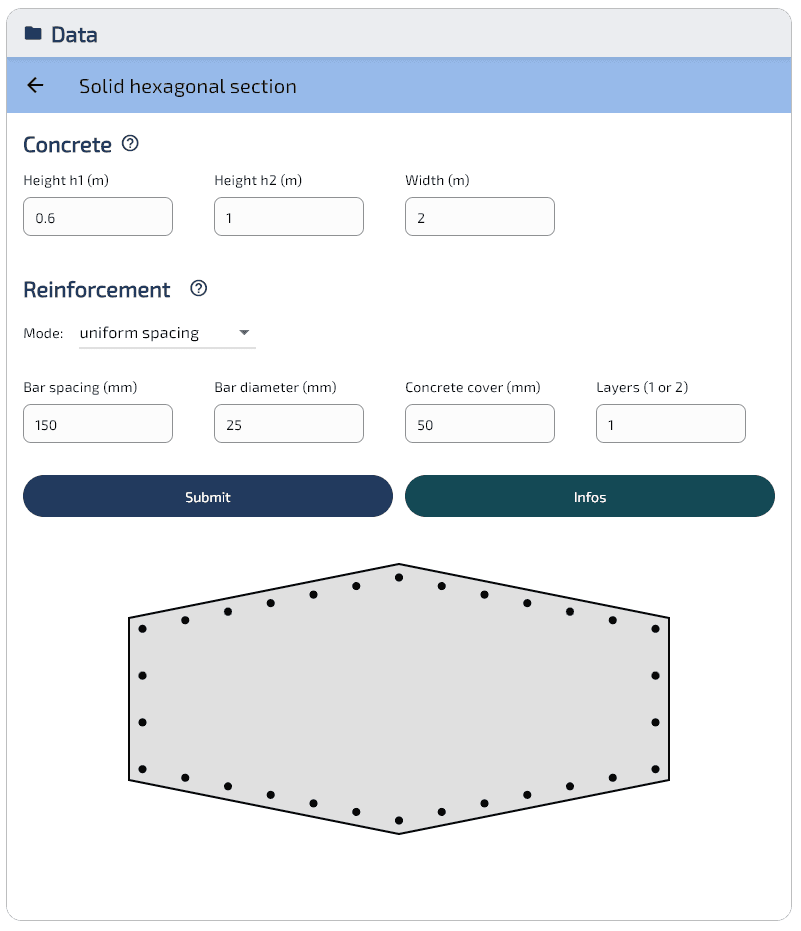
- Concrete — Hexagonal cross section, width m, minimum thickness m, maximum thickness m.
- Reinforcement layout — Uniform spacing 150 mm, 30 bar positions, cover 50 mm, 1 layer, diameter : to be determined.
- Material laws (EC2) — Concrete C30/37: MPa, Steel B500B: MPa.
SLS — Combined bending (N + Mz)
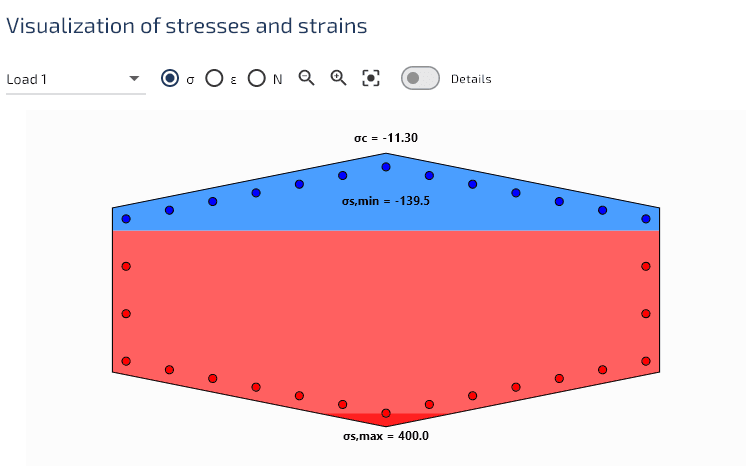
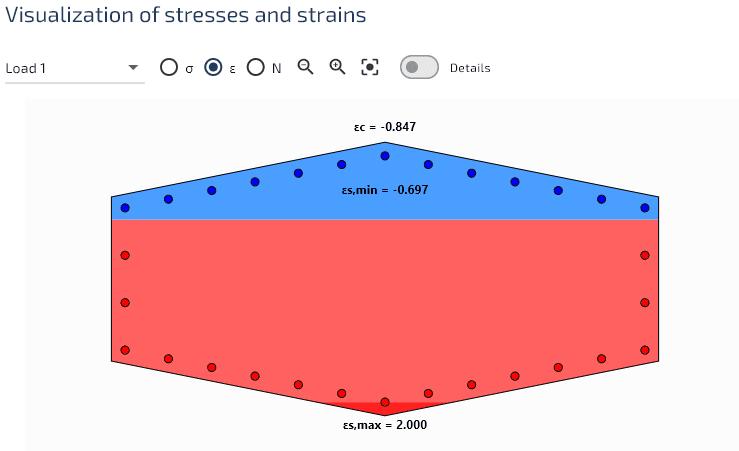
Imposed loads: kN, kN·m,
| Stresses & strains + design | Value |
|---|---|
| MPa | |
| MPa | |
| MPa | |
| ‰ | |
| ‰ | |
| ‰ | |
| Pivot | A |
| 17.60 mm |
| Internal forces | Value |
|---|---|
| kN | |
| kN | |
| m | |
| m | |
| m | |
| m | |
| m |
| Convergence | Value |
|---|---|
| Tol | |
| kN | |
| kN·m | |
| kN·m | |
Pivot A: the steel governs (‰ ). The required diameter is mm for all 30 bar positions.
ULS — Biaxial bending (N + My + Mz)
Imposed loads: kN, kN·m, kN·m
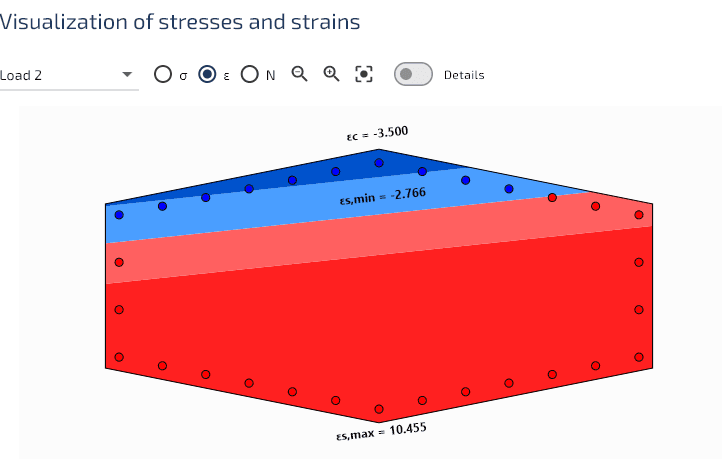
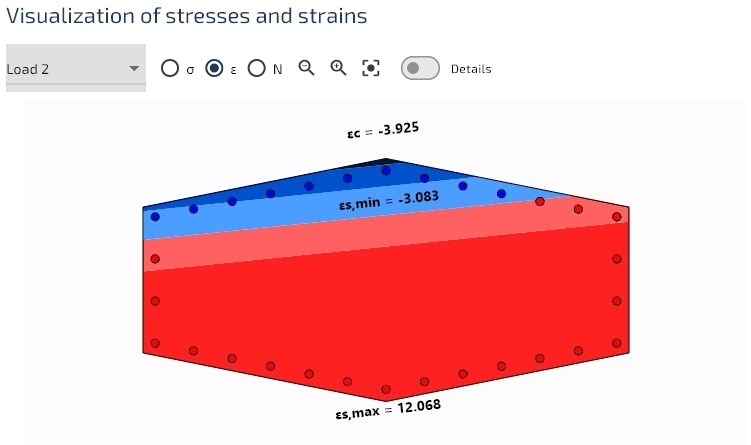
| Stresses & strains + design | Value |
|---|---|
| MPa | |
| MPa | |
| MPa | |
| ‰ | |
| ‰ | |
| ‰ | |
| Pivot | B |
| 25.12 mm |
| Internal forces | Value |
|---|---|
| kN | |
| kN | |
| m | |
| m | |
| m | |
| m | |
| m |
| Convergence | Value |
|---|---|
| Tol | |
| kN | |
| kN·m | |
| kN·m | |
Pivot B: the concrete governs (‰ ). The required diameter is mm for the ULS biaxial loading.
Hollow square section
Input data
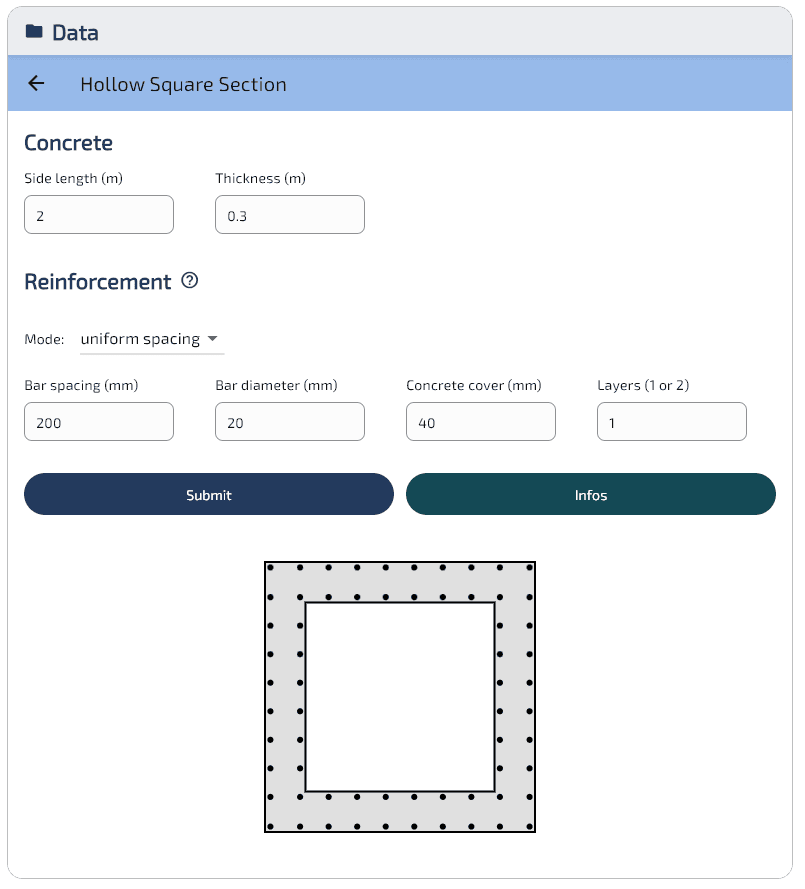
- Concrete — Hollow square section, outer side m, wall thickness m.
- Reinforcement layout — Uniform spacing 150 mm, 64 bar positions, cover 40 mm, 1 layer per face (inner + outer), diameter : to be determined.
- Material laws (NBR-6118) — Concrete C30: MPa, Steel: MPa.
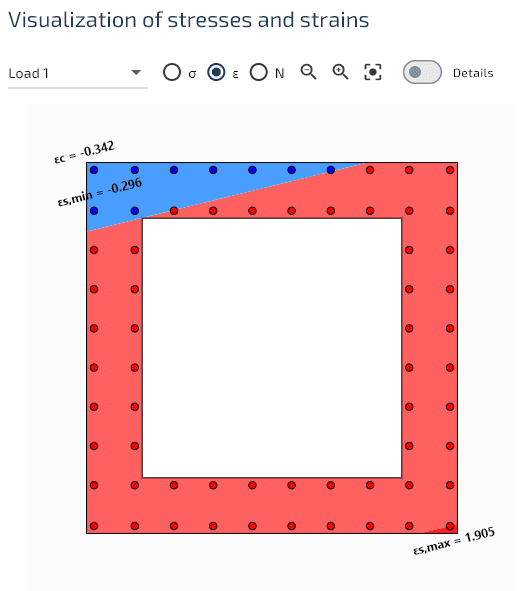
SLS — Biaxial bending (N + My + Mz)
Imposed loads: kN, kN·m, kN·m
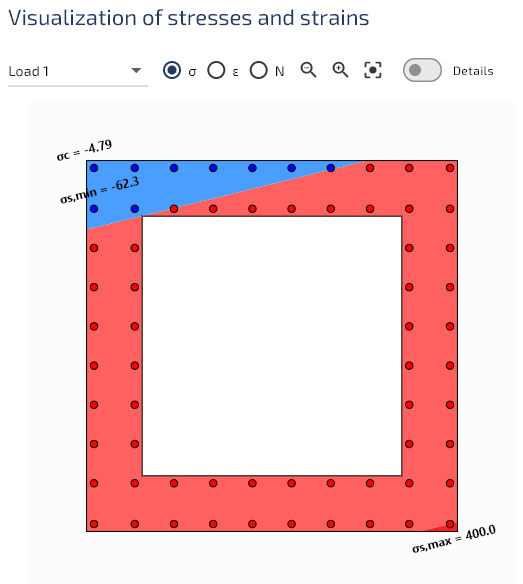
| Stresses & strains + design | Value |
|---|---|
| MPa | |
| MPa | |
| MPa | |
| ‰ | |
| ‰ | |
| ‰ | |
| Pivot | A |
| 10.00 mm |
| Internal forces | Value |
|---|---|
| kN | |
| kN | |
| m | |
| m | |
| m | |
| m | |
| m |
| Convergence | Value |
|---|---|
| Tol | |
| kN | |
| kN·m | |
| kN·m | |
Pivot A: the steel governs (‰ ). The required diameter is mm.
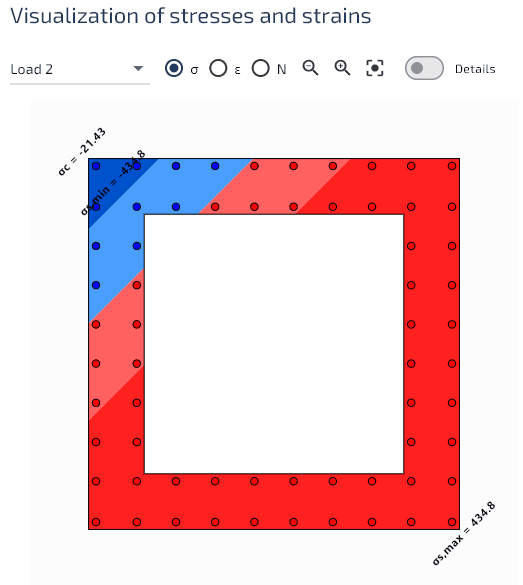
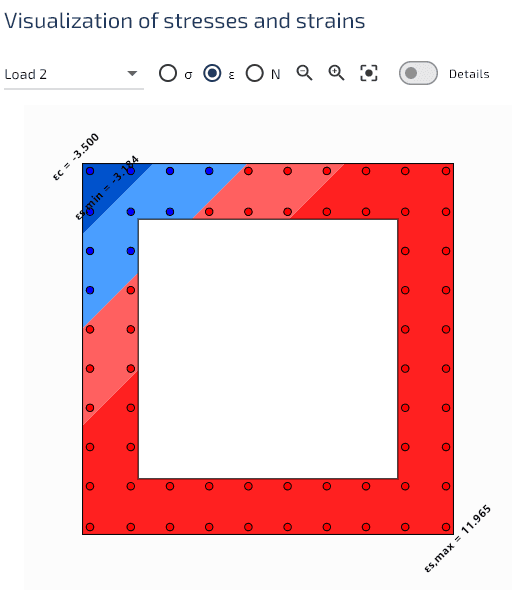
ULS — Biaxial bending (N + My + Mz)
Imposed loads: kN, kN·m, kN·m
| Stresses & strains + design | Value |
|---|---|
| MPa | |
| MPa | |
| MPa | |
| ‰ | |
| ‰ | |
| ‰ | |
| Pivot | B |
| 19.38 mm |
| Internal forces | Value |
|---|---|
| kN | |
| kN | |
| m | |
| m | |
| m | |
| m | |
| m |
| Convergence | Value |
|---|---|
| Tol | |
| kN | |
| kN·m | |
| kN·m | |
Pivot B: the concrete governs (‰ ). The required diameter is mm for the ULS biaxial loading.
Custom section — U-beam
Input data
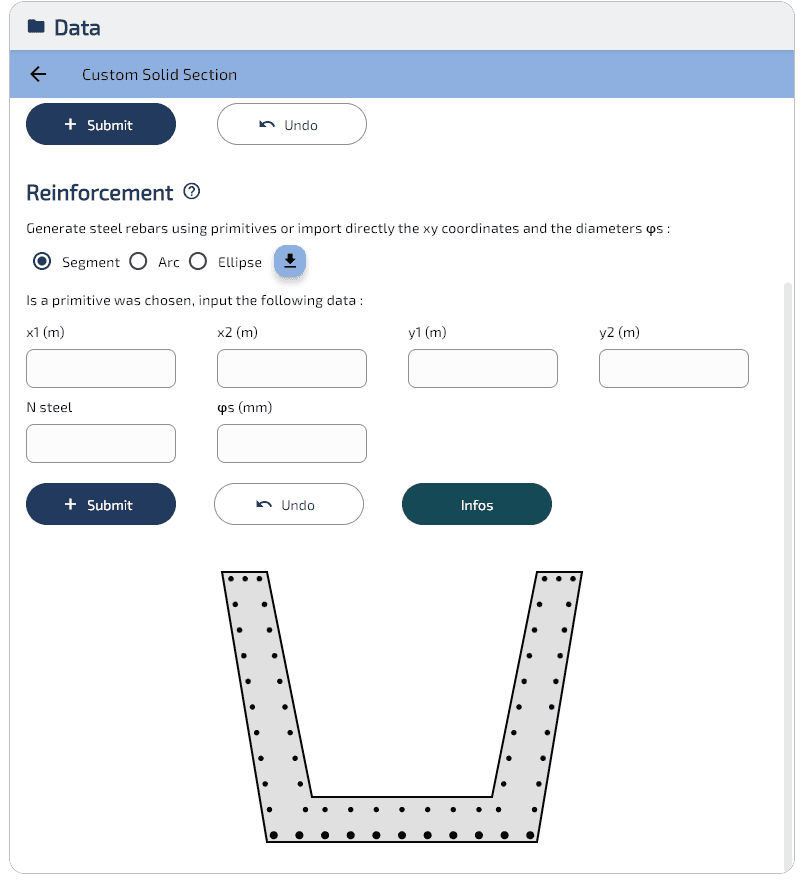
This section uses the custom solid geometry feature. The external contour is defined as a list of XY points, and the reinforcement layout is provided as a table of positions. This is the recommended procedure for non-standard geometries that do not fit predefined parametric shapes.
- Concrete — U-beam with inclined webs, total height m.
- Reinforcement layout — Uniform spacing 150 mm, bottom slab: 11 positions, webs: 49 positions, 2 layers per web, diameter : to be determined.
- Material laws (BAEL 91) — Concrete: MPa, , Steel fe500: MPa.
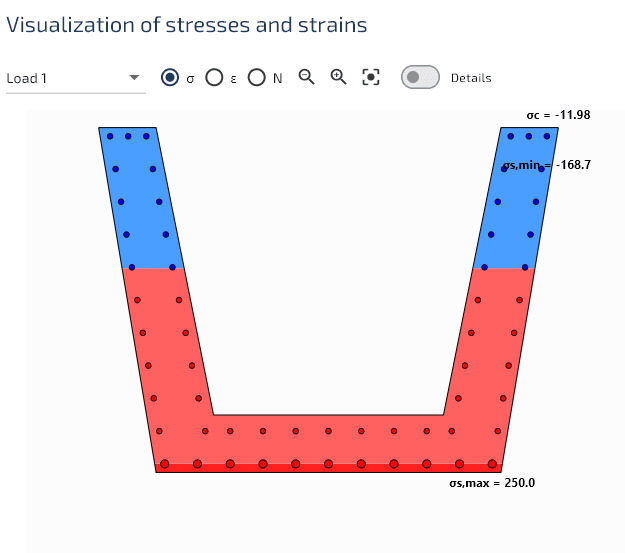
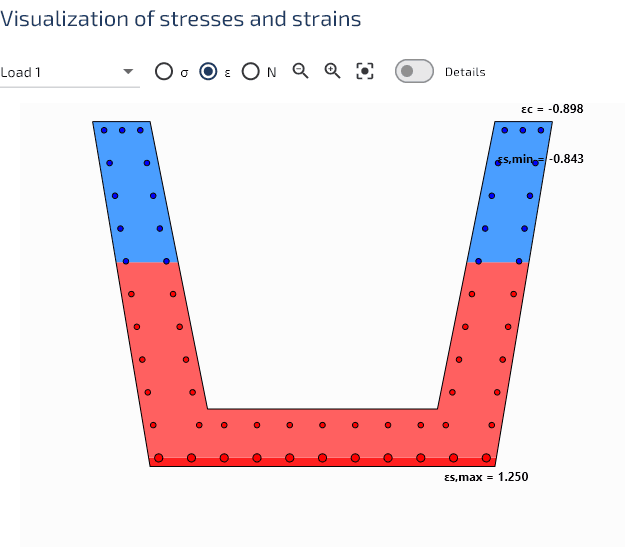
SLS — Pure bending (Mz)
Imposed loads: kN, kN·m,
| Stresses & strains + design | Value |
|---|---|
| MPa | |
| MPa | |
| MPa | |
| ‰ | |
| ‰ | |
| ‰ | |
| Pivot | A |
| 17.88 mm |
| Internal forces | Value |
|---|---|
| kN | |
| kN | |
| m | |
| m | |
| m | |
| m | |
| m |
| Convergence | Value |
|---|---|
| Tol | |
| kN | |
| kN·m | |
| kN·m | |
Pivot A: the steel governs ( MPa , the BAEL allowable stress for prejudicial cracking). The required diameter is mm applied uniformly to all 60 bar positions.
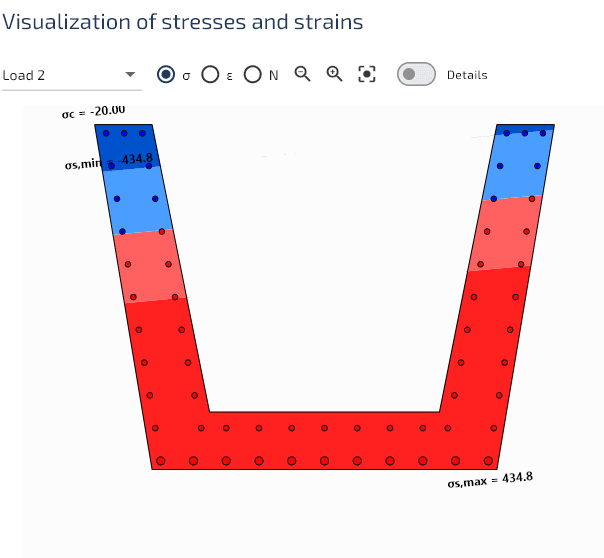
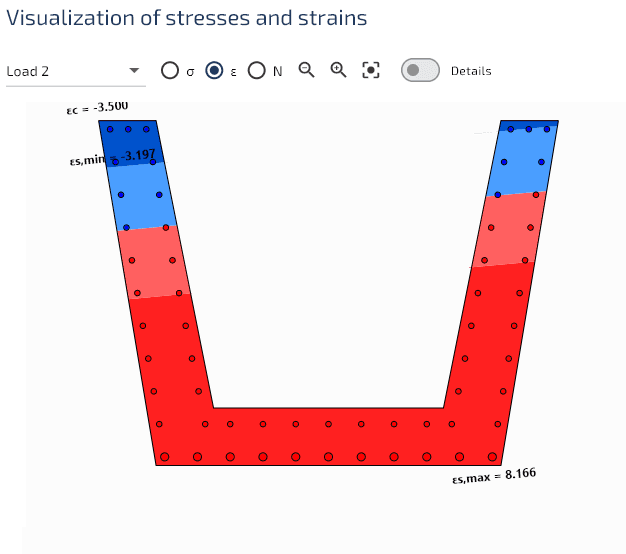
ULS — Biaxial bending (My + Mz)
Imposed loads: kN, kN·m, kN·m
| Stresses & strains + design | Value |
|---|---|
| MPa | |
| MPa | |
| MPa | |
| ‰ | |
| ‰ | |
| ‰ | |
| Pivot | B |
| 13.26 mm |
| Internal forces | Value |
|---|---|
| kN | |
| kN | |
| m | |
| m | |
| m | |
| m | |
| m |
| Convergence | Value |
|---|---|
| Tol | |
| kN | |
| kN·m | |
| kN·m | |
Pivot B: the concrete governs (‰ ). The required diameter is mm for the ULS biaxial loading.
Results validation
Internal equilibrium check
The imposed loads are the input. SectionPro finds the bar diameter and the corresponding strain state by iterative solving, then integrates stresses over the section to obtain the internal forces . At convergence, these must match the imposed loads.
| Section | Load | (kN) | (kN) | (kN·m) | (kN·m) | Δ |
|---|---|---|---|---|---|---|
| Hexagonal | SLS | 0.00 % | ||||
| ULS | 0.00 % | |||||
| Hollow sq. | SLS | 0.00 % | ||||
| ULS | 0.00 % | |||||
| U-beam | SLS | 0.00 % | ||||
| ULS | 0.00 % |
Internal equilibrium is satisfied to machine precision for all six load cases — across three different geometries, three normative codes, and both linear (SLS) and nonlinear (ULS) material laws.
Cross-reference with Article #2
The table below compares the factor of safety from Article #2 (fixed reinforcement) with the required computed in this article. The reinforcement design applies a uniform to all bar positions.
| Section | Load | (Art. #2) | FS (Art. #2) | Check (Art. #2) | Pivot | required |
|---|---|---|---|---|---|---|
| Hexagonal | SLS | 25 mm | OK | A | 17.6 mm | |
| ULS | 25 mm | KO | B | 25.1 mm | ||
| Hollow sq. | SLS | 20 mm | OK | A | 10.0 mm | |
| ULS | 20 mm | OK | B | 19.4 mm | ||
| U-beam | SLS | 20/12 mm | KO | A | 17.9 mm | |
| ULS | 20/12 mm | OK | B | 13.3 mm |
For uniform-reinforcement sections (hexagonal and hollow square), the correlation is straightforward: FS implies and vice versa. For the U-beam, which had mixed diameters, the comparison must be made on total steel area rather than on alone.
Performance benchmark — 100,000 load cases
To demonstrate SectionPro's suitability for systematic reinforcement design, we run 100,000 load cases on each of the three sections defined above. The load cases combine SLS and ULS, uniaxial and biaxial bending. The benchmark measures the pure computation time, excluding UI overhead. Convergence was obtained for all 300,000 load cases.
| Metric | Hexagonal | Hollow square | U-beam |
|---|---|---|---|
| Load cases | 100,000 | 100,000 | 100,000 |
| Computation time | 5.26 s | 5.30 s | 5.35 s |
| Rate | 19,000 loads/s | 18,900 loads/s | 18,700 loads/s |
All three sections complete in approximately 5.3 seconds for 100,000 load cases — rates of 18,700 to 19,000 designs per second. This is slower than the stress verification (Article #2), which is expected: the reinforcement design adds an outer iteration loop on , with each iteration requiring a full solve on the strain state .
Convergence was obtained for all 300,000 load cases, across all three geometries, normative codes, and limit states. Despite this additional layer, SectionPro designs 100,000 load cases in under 6 seconds, making it practical for systematic reinforcement design of large load envelopes.
Export
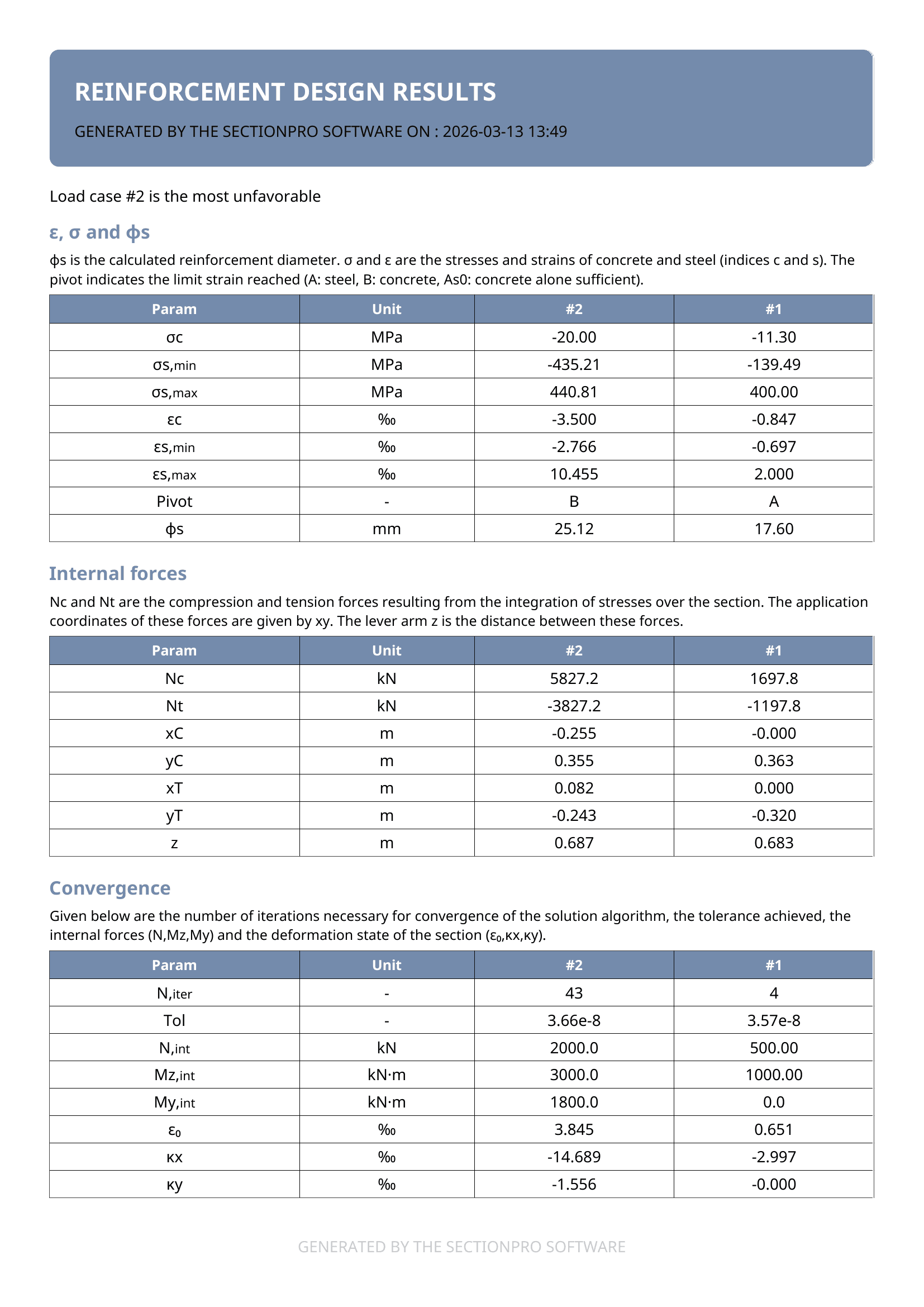
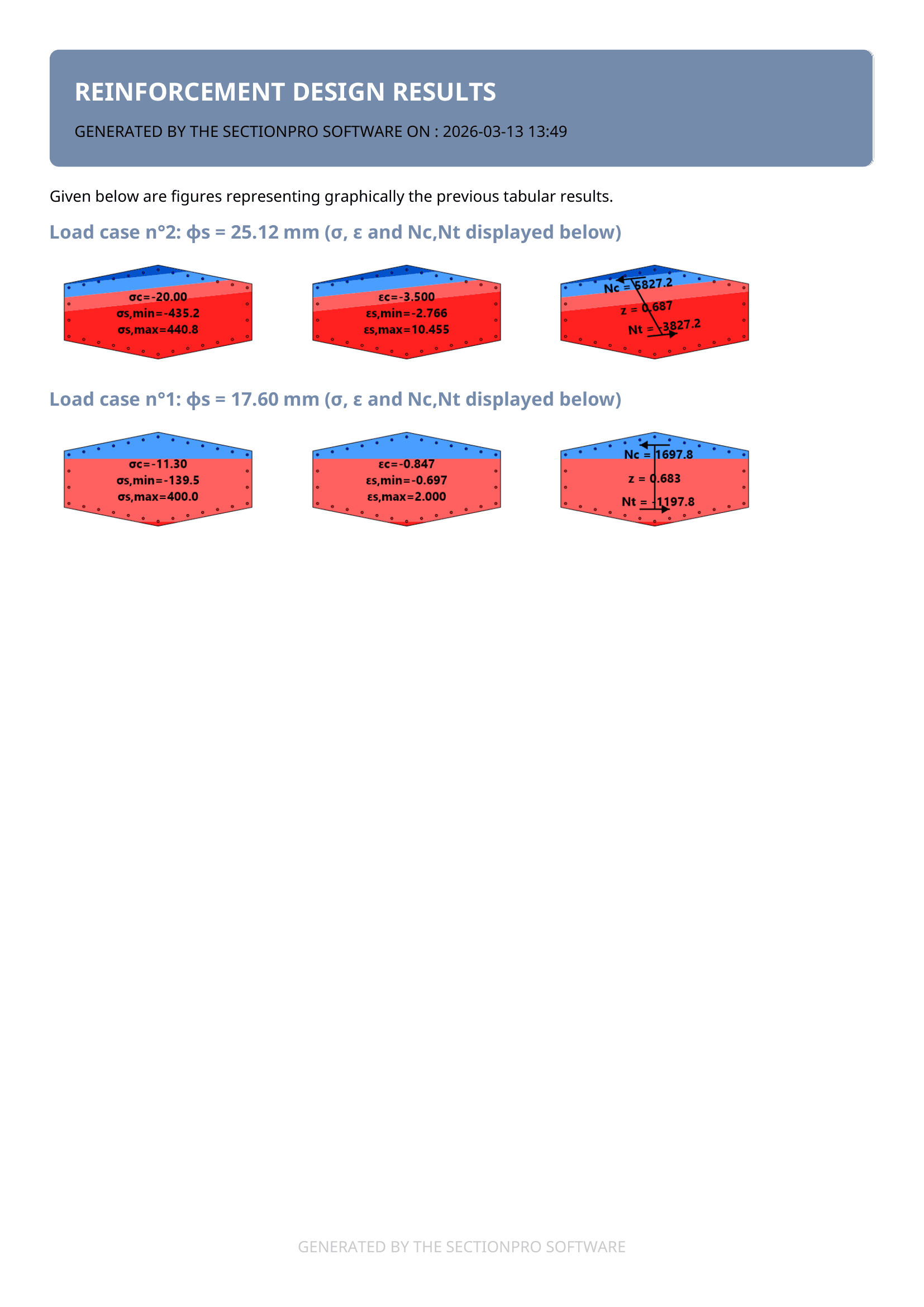
SectionPro exports results in three formats: PDF, text (fixed-width columns), and Excel (.xlsx). The exported data includes, per load case: stresses and strains, the failure pivot, the required bar diameter , internal forces (with centroids and lever arm), and full convergence information.
Conclusion
In practice, a structural engineer typically faces two complementary problems: either verifying a section with known reinforcement — as covered in Article #2 — or determining the reinforcement required to resist a given set of loads. The reinforcement design feature addresses the second case directly. When the bar layout is known but the diameter is not yet fixed, SectionPro finds the minimum such that the section is loaded exactly to 100% of its capacity under the normative strain limits. This gives the engineer the strictly minimal reinforcement as a starting point, from which a practical bar diameter can be selected.
The results are consistent with the inverse problem formulation: internal equilibrium is satisfied to machine precision for all load cases, across three different geometries, three normative codes, and both SLS and ULS limit states. The solver converges reliably in all cases. As for performance, the benchmark of 100,000 load cases serves as an upper bound — in practice, a structural engineer typically works with a few hundred load combinations. At the measured rate of ~19,000 designs per second, 500 combinations complete in under 30 milliseconds: the computation is essentially instantaneous.