

Introduction
The mechanical properties of a section — area, moments of inertia, centroid, torsion constant, shear areas — are the starting point of any structural analysis. This article shows how to obtain them with SectionPro, on three different geometries:
- Square section — the simplest case, all properties can be computed analytically.
- Hollow circular section — torsion and inertia remain analytical, but shear areas require a numerical computation.
- L-shaped wall — only the geometric properties are analytical. Torsion, shear, and warping are purely numerical. This section illustrates the case of an asymmetric geometry ().
Computed properties
SectionPro computes the following properties. The first three groups are calculated for the gross section, net section (deducting voids at reinforcement locations), and transformed section (accounting for reinforcement through the modular ratio ):
General results
Centroidal axes
Principal axes
Torsion & shear (FEM)
The torsion and shear properties require solving a differential equation using the finite element method.
Square section
Input data
- Concrete — Side length m, density t/m³.
- Reinforcement — HA25 at 200 mm spacing, cover 50 mm, 1 layer, modular ratio .
Input and results
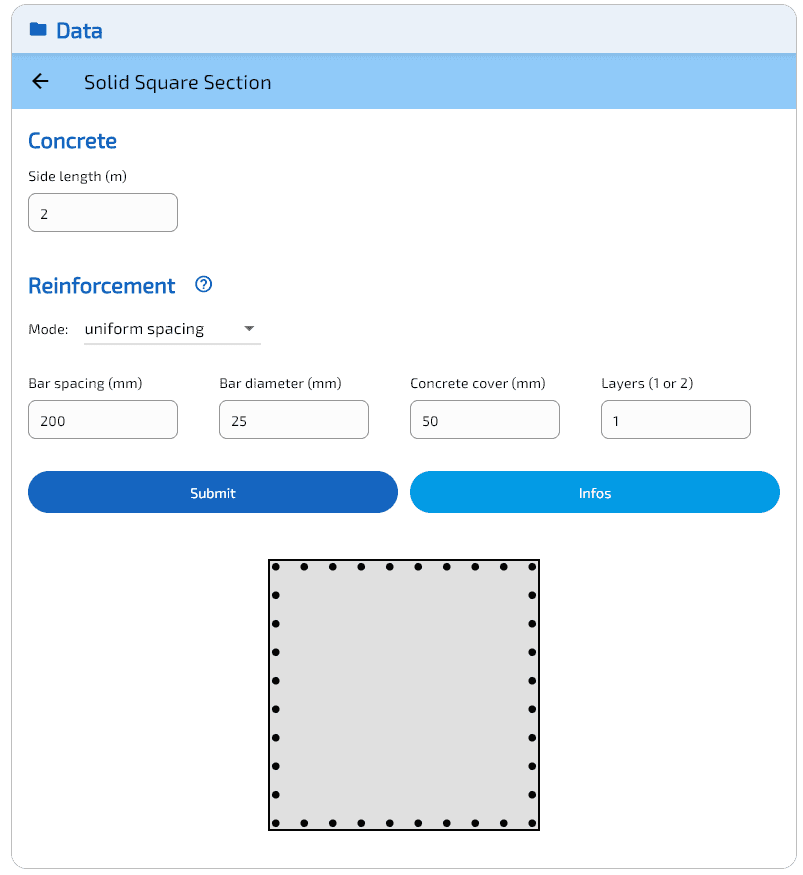
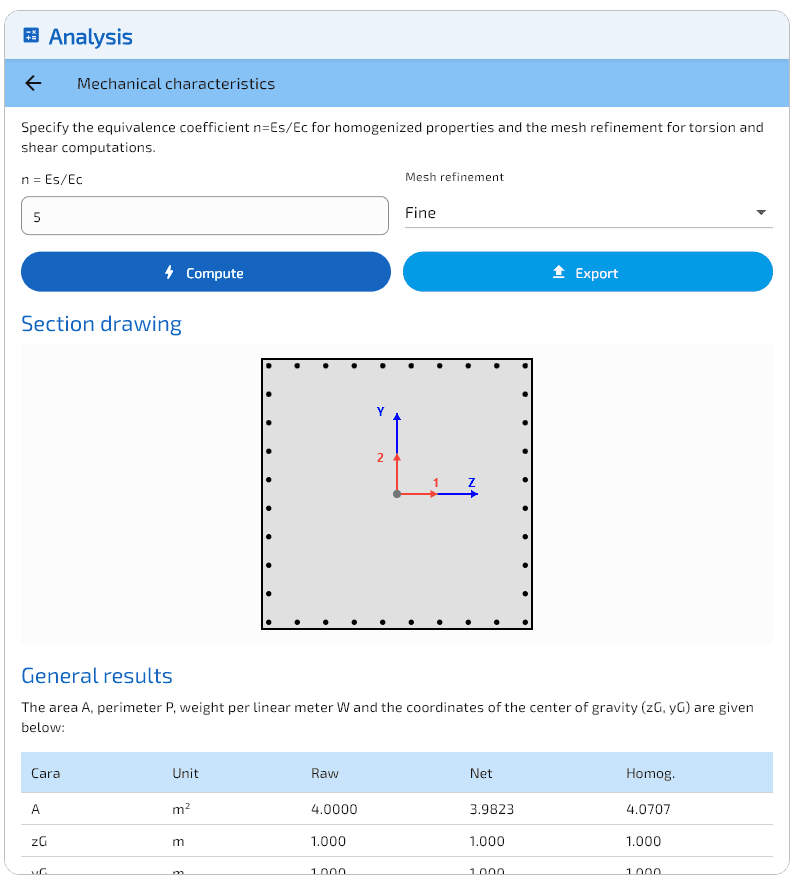
Due to double symmetry, the centroid lies at the center of the square, the principal angle is zero, and both moments of inertia are equal.
General results
| Unit | Gross | Net | Transf. | |
|---|---|---|---|---|
| m² | 4.0000 | 3.9823 | 4.0707 | |
| m | 1.0000 | 1.0000 | 1.0000 | |
| m | 1.0000 | 1.0000 | 1.0000 | |
| m | 8.0000 | — | — | |
| T/m | 10.0000 | — | — |
Bending — Centroidal axes
| Unit | Gross | Net | Transf. | |
|---|---|---|---|---|
| m⁴ | 1.3333 | 1.3226 | 1.3761 | |
| m⁴ | 1.3333 | 1.3226 | 1.3761 | |
| m | 1.0000 | 1.0000 | 1.0000 | |
| m | 1.0000 | 1.0000 | 1.0000 | |
| m | 1.0000 | 1.0000 | 1.0000 | |
| m | 1.0000 | 1.0000 | 1.0000 |
Bending — Principal axes
| Unit | Gross | Net | Transf. | |
|---|---|---|---|---|
| m⁴ | 1.3333 | 1.3226 | 1.3761 | |
| m⁴ | 1.3333 | 1.3226 | 1.3761 | |
| m | 1.0000 | 1.0000 | 1.0000 | |
| m | 1.0000 | 1.0000 | 1.0000 | |
| m | 1.0000 | 1.0000 | 1.0000 | |
| m | 1.0000 | 1.0000 | 1.0000 | |
| ° | 0.00 | 0.00 | 0.00 |
Torsion and shear (FEM)
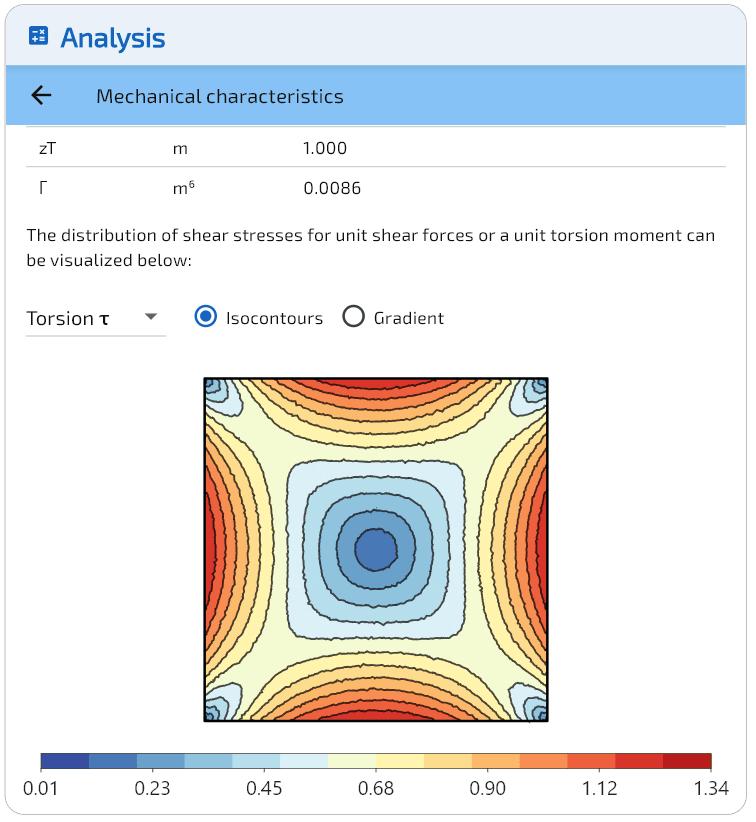
Due to double symmetry, the shear center coincides with the centroid ( m). Warping is nearly zero (). The ratio , typical of a solid section.
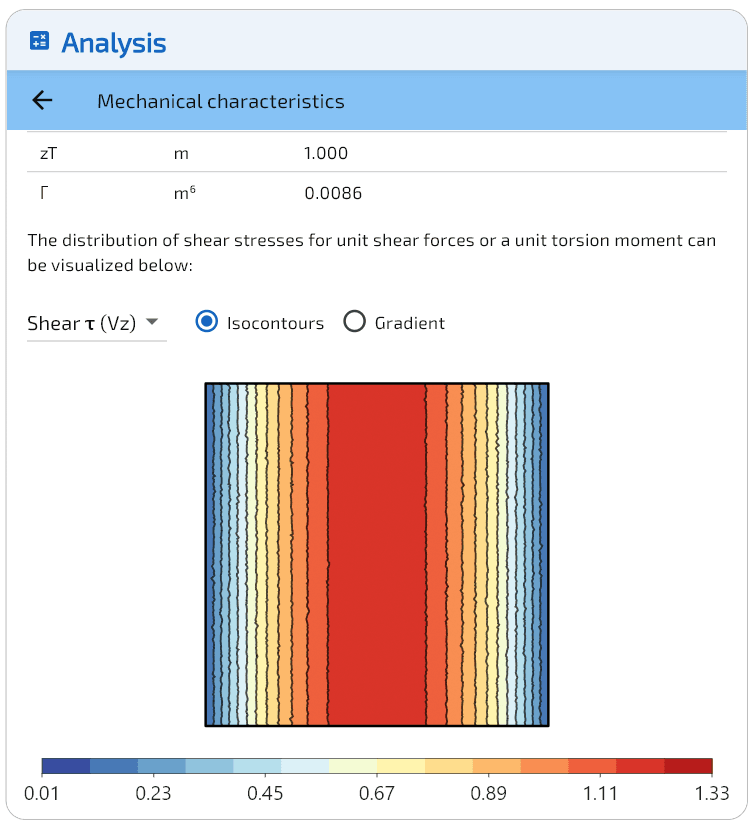
| Unit | m⁴ | m² | m² | m | m | m⁶ |
| Value | 2.2492 | 3.3333 | 3.3333 | 1.0000 | 1.0000 | 0.0086 |
Hollow circular section
Input data
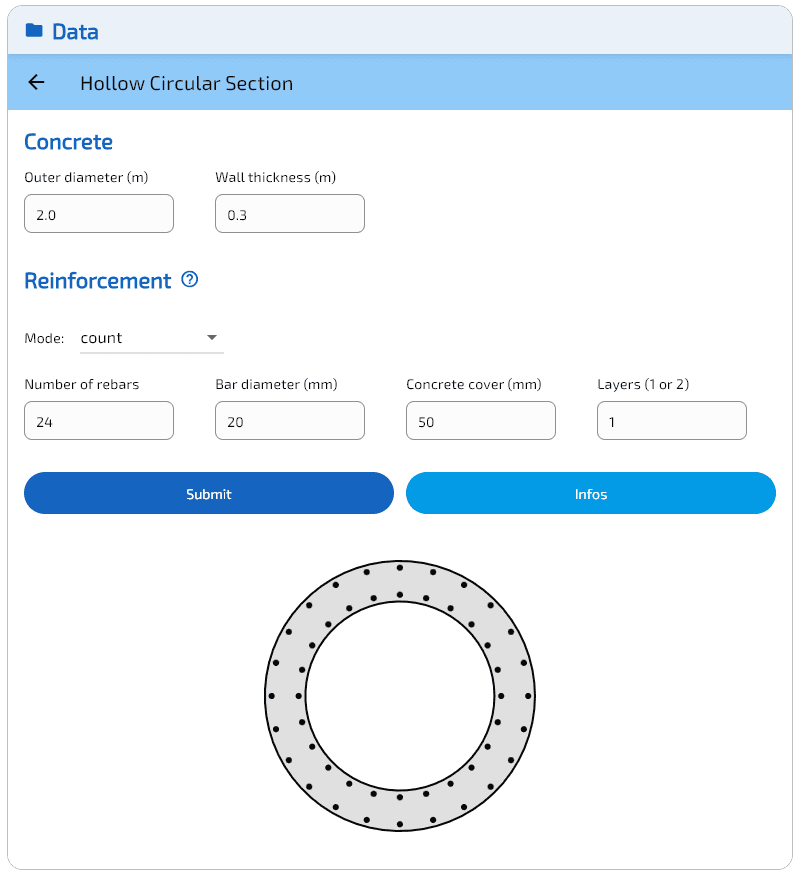
- Concrete — Outer diameter m, wall thickness m, density t/m³.
- Reinforcement — 24 HA20, cover 50 mm, 1 layer, modular ratio .
Input and results
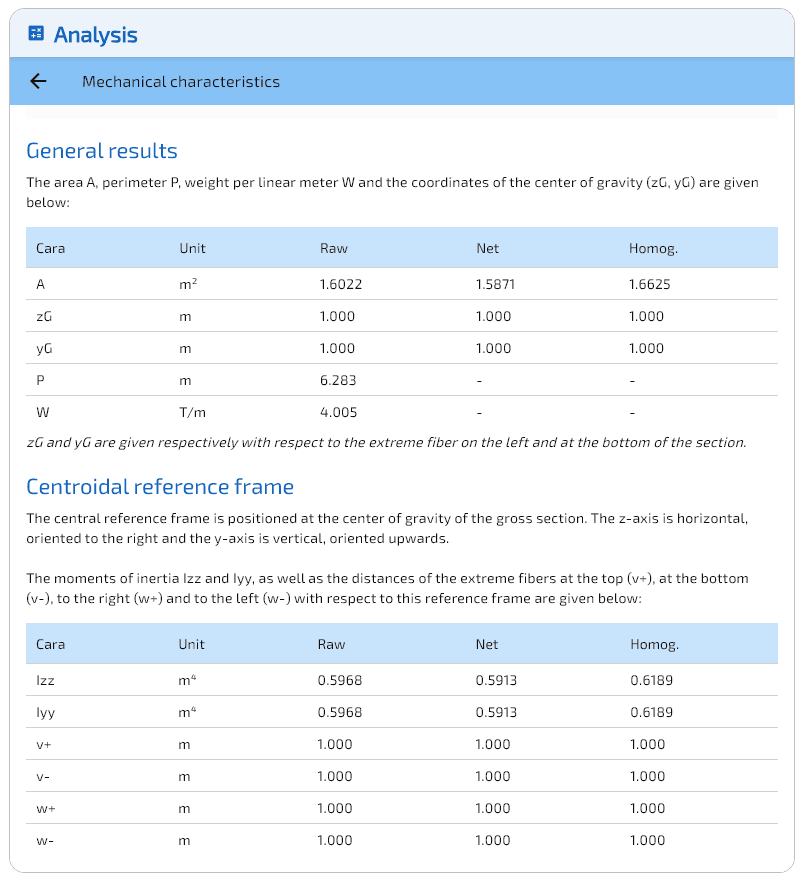
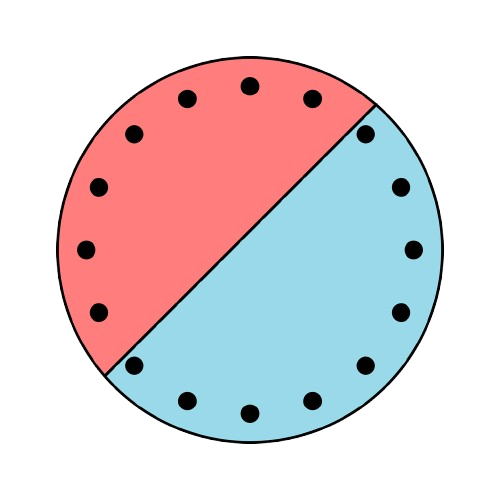
Due to circular symmetry, the moments of inertia are equal and the principal angle is indeterminate (displayed as 0°).
General results
| Unit | Gross | Net | Transf. | |
|---|---|---|---|---|
| m² | 1.6022 | 1.5871 | 1.6625 | |
| m | 1.0000 | 1.0000 | 1.0000 | |
| m | 1.0000 | 1.0000 | 1.0000 | |
| m | 6.2832 | — | — | |
| T/m | 4.0055 | — | — |
Bending — Centroidal axes
| Unit | Gross | Net | Transf. | |
|---|---|---|---|---|
| m⁴ | 0.5968 | 0.5913 | 0.6189 | |
| m⁴ | 0.5968 | 0.5913 | 0.6189 | |
| m | 1.0000 | 1.0000 | 1.0000 | |
| m | 1.0000 | 1.0000 | 1.0000 | |
| m | 1.0000 | 1.0000 | 1.0000 | |
| m | 1.0000 | 1.0000 | 1.0000 |
Bending — Principal axes
| Unit | Gross | Net | Transf. | |
|---|---|---|---|---|
| m⁴ | 0.5968 | 0.5913 | 0.6189 | |
| m⁴ | 0.5968 | 0.5913 | 0.6189 | |
| m | 1.0000 | 1.0000 | 1.0000 | |
| m | 1.0000 | 1.0000 | 1.0000 | |
| m | 1.0000 | 1.0000 | 1.0000 | |
| m | 1.0000 | 1.0000 | 1.0000 | |
| ° | 0.00 | 0.00 | 0.00 |
Torsion and shear (FEM)
Due to rotational symmetry, the shear center coincides with the centroid ( m) and warping is zero (). The ratio : the hollow section is less efficient in shear than a solid section.
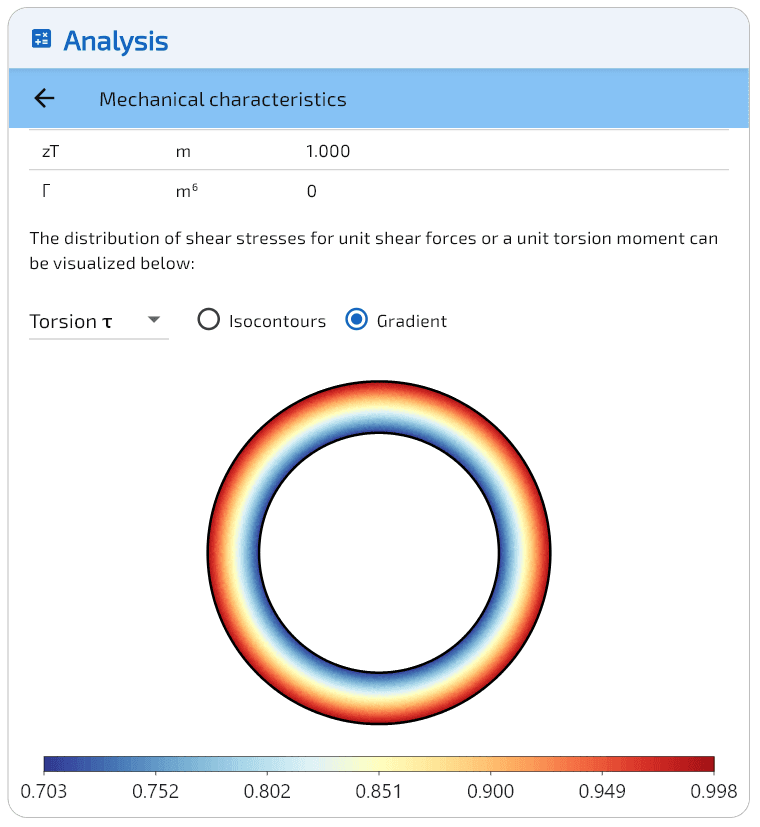
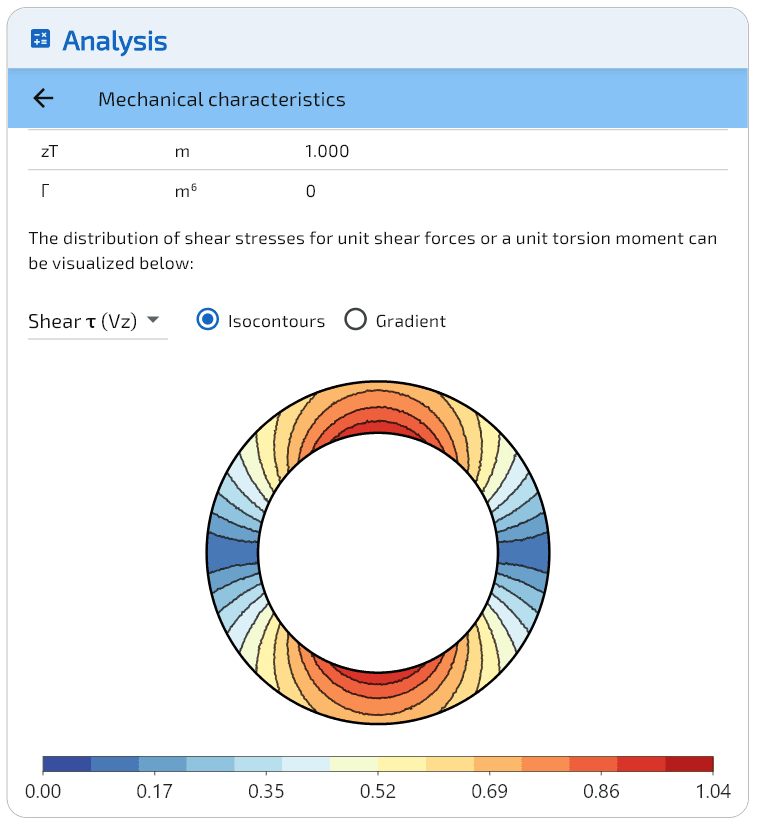
| Unit | m⁴ | m² | m² | m | m | m⁶ |
| Value | 1.1936 | 0.8422 | 0.8422 | 1.0000 | 1.0000 | 0.0000 |
L-shaped wall
Input data
- Concrete — L-shape, width 2.0 m, height 2.0 m, thickness m, density t/m³.
- Reinforcement — HA20 at 200 mm spacing, cover 40 mm, 1 layer, modular ratio .
Input and results
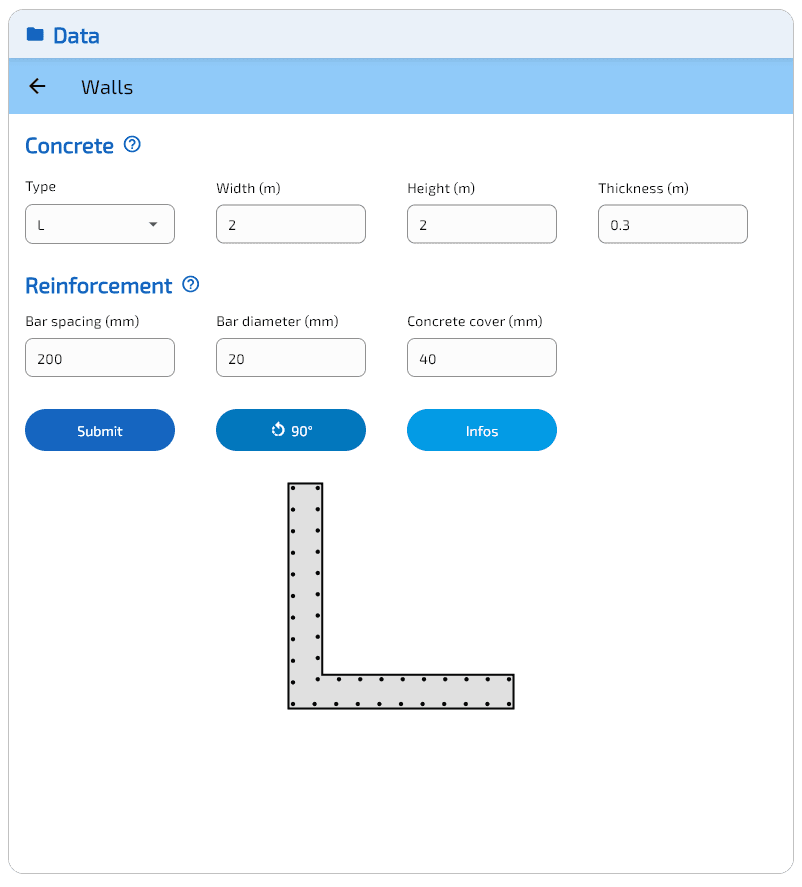
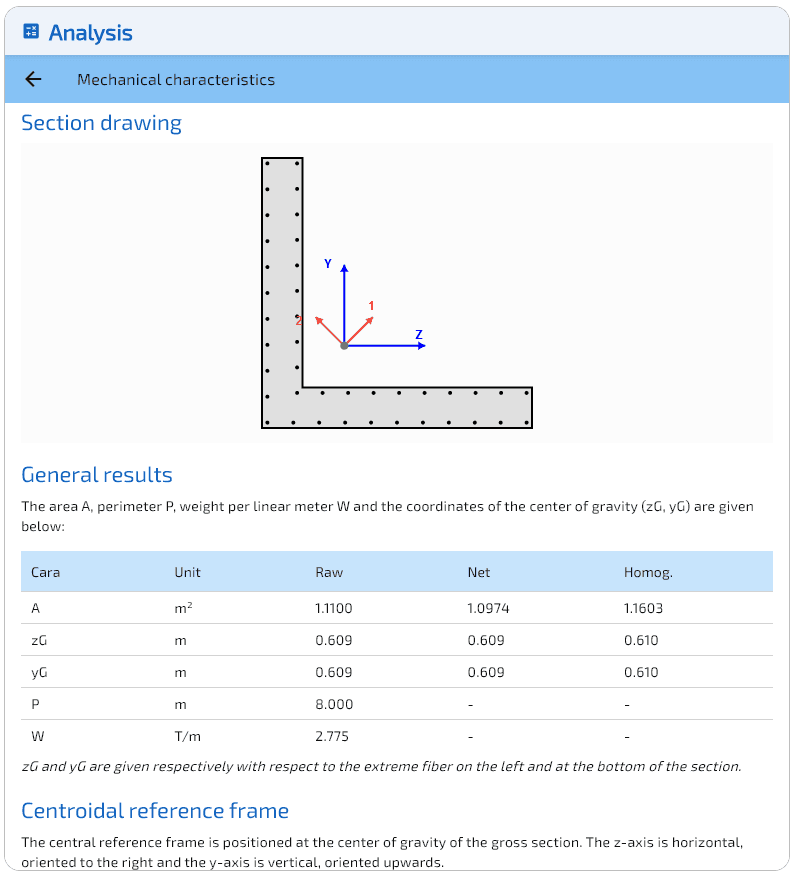
Since both flanges have the same length, and the principal angle is exactly .
General results
| Unit | Gross | Net | Transf. | |
|---|---|---|---|---|
| m² | 1.1100 | 1.0974 | 1.1603 | |
| m | 0.6095 | 0.6093 | 0.6100 | |
| m | 0.6095 | 0.6093 | 0.6100 | |
| m | 8.0000 | — | — | |
| T/m | 2.7750 | — | — |
Bending — Centroidal axes
| Unit | Gross | Net | Transf. | |
|---|---|---|---|---|
| m⁴ | 0.4030 | 0.3981 | 0.4225 | |
| m⁴ | 0.4030 | 0.3981 | 0.4225 | |
| m | 1.3905 | 1.3907 | 1.3900 | |
| m | 0.6095 | 0.6093 | 0.6100 | |
| m | 1.3905 | 1.3907 | 1.3900 | |
| m | 0.6095 | 0.6093 | 0.6100 |
Bending — Principal axes
| Unit | Gross | Net | Transf. | |
|---|---|---|---|---|
| m⁴ | 0.6373 | 0.6297 | 0.6679 | |
| m⁴ | 0.1687 | 0.1666 | 0.1771 | |
| m | 1.4142 | 1.4142 | 1.4142 | |
| m | 1.4142 | 1.4142 | 1.4142 | |
| m | 0.7644 | 0.7644 | 0.7644 | |
| m | 0.8619 | 0.8619 | 0.8619 | |
| ° | 45.00 | 45.00 | 45.00 |
Torsion and shear (FEM)
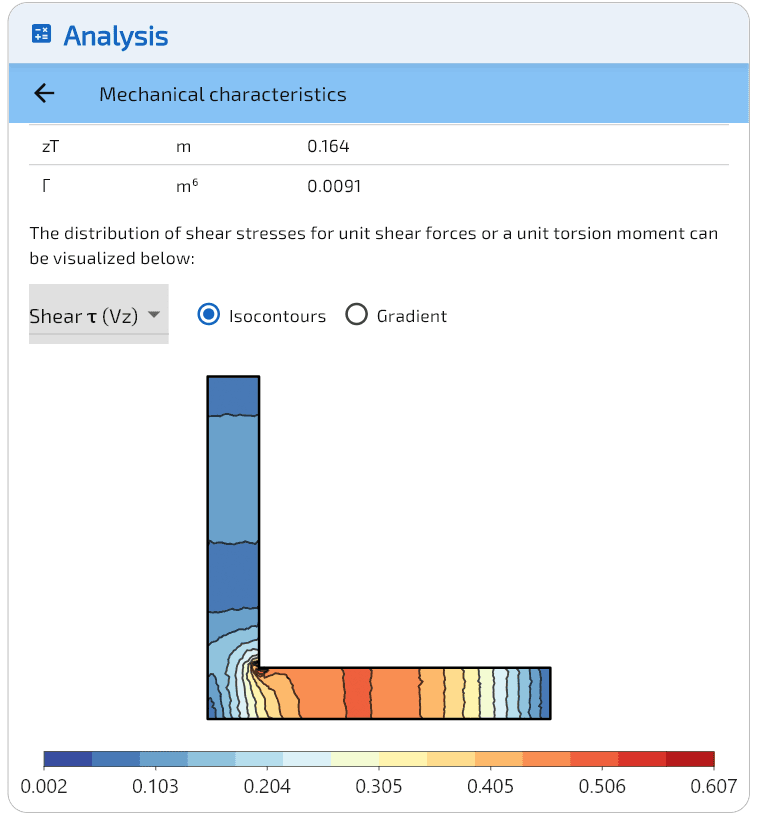
The shear center ( m) is offset toward the re-entrant corner, far from the centroid ( m). Warping is significant ( m⁶). The torsion constant m⁴ is very small — typical of an open thin-walled section. The ratio .
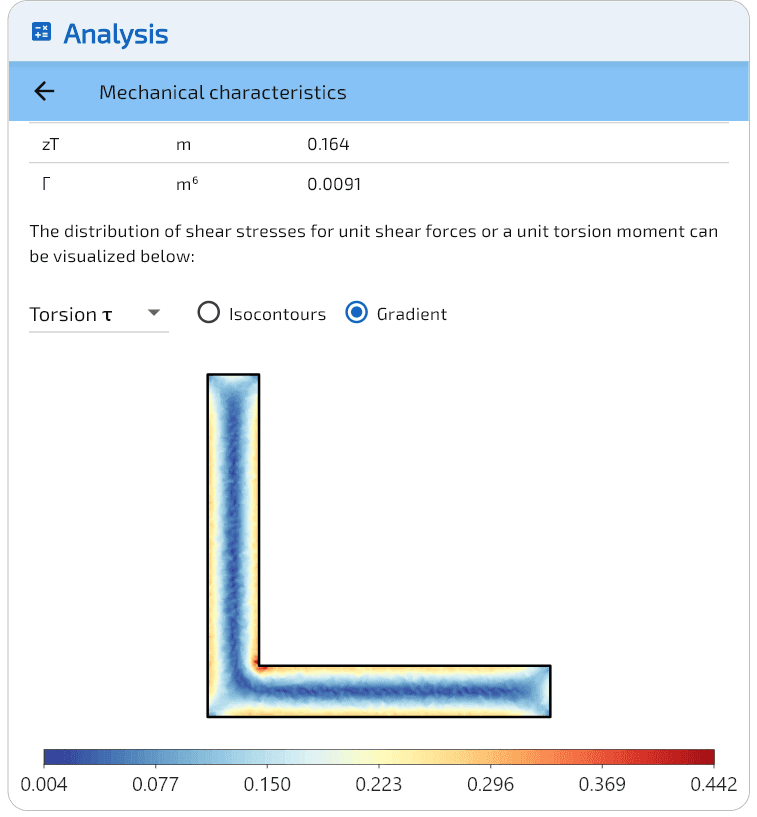
| Unit | m⁴ | m² | m² | m | m | m⁶ |
| Value | 0.0322 | 0.5037 | 0.5037 | 0.1637 | 0.1637 | 0.0091 |
Results validation
SectionPro results are validated in two ways: by comparison with analytical formulas (when they exist) and by cross-validation with reference software using an independent finite element solver.
Analytical formulas
Square section ( m)
The torsion constant is obtained from the Saint-Venant series:
Hollow circular section ( m, m)
Shear areas do not have a simple closed-form expression; the differential equation must be solved numerically.
L-shaped wall ( m, m)
By decomposition (flange + web ) and the Parallel Axis Theorem:
There is no exact analytical formula for torsion, shear, and warping. However, Vlasov beam theory (open thin-walled sections) provides an order of magnitude: m⁴ and the shear center lies approximately at the intersection of the flange mid-lines ( m). These estimates assume an infinitely small thickness compared to the flange length; here , and thickness effects shift the actual values from this simplified model.
Net and transformed sections
For a section reinforced with steel bars of area at coordinates , with modular ratio :
The centroid shifts slightly:
The moment of inertia is derived using the Parallel Axis Theorem, accounting for the centroid shift :
Validation — Bending properties
The analytical formulas above were applied to all three sections using the exact reinforcement coordinates exported by SectionPro. All results match.
| Section | Property | Gross | Δ | Net | Δ | Transf. | Δ |
|---|---|---|---|---|---|---|---|
| Square | (m²) | 4.0000 | 0.00 % | 3.9823 | 0.00 % | 4.0707 | 0.00 % |
| (m) | 1.0000 | 0.00 % | 1.0000 | 0.00 % | 1.0000 | 0.00 % | |
| (m⁴) | 1.3333 | 0.00 % | 1.3226 | 0.00 % | 1.3761 | 0.00 % | |
| Hollow circ. | (m²) | 1.6022 | 0.00 % | 1.5871 | 0.00 % | 1.6625 | 0.00 % |
| (m) | 1.0000 | 0.00 % | 1.0000 | 0.00 % | 1.0000 | 0.00 % | |
| (m⁴) | 0.5968 | 0.00 % | 0.5913 | 0.00 % | 0.6189 | 0.00 % | |
| L-wall | (m²) | 1.1100 | 0.00 % | 1.0974 | 0.00 % | 1.1603 | 0.00 % |
| (m) | 0.6095 | 0.00 % | 0.6093 | 0.00 % | 0.6100 | 0.00 % | |
| (m⁴) | 0.4030 | 0.00 % | 0.3981 | 0.00 % | 0.4225 | 0.00 % |
Validation — Torsion and shear (cross-validation)
Torsion and shear properties, computed by finite elements, are compared with reference software using an independent solver.
| Section | Property | Analytical | SectionPro | Δ | Ref. | Δ |
|---|---|---|---|---|---|---|
| Square | (m⁴) | 2.2489 | 2.2492 | 0.01 % | 2.2585 | 0.41 % |
| (m²) | 3.3333 | 3.3333 | 0.00 % | 3.3355 | 0.07 % | |
| (m) | 1.0000 | 1.0000 | 0.00 % | 1.0000 | 0.00 % | |
| Hollow circ. | (m⁴) | 1.1936 | 1.1936 | 0.00 % | 1.1920 | 0.13 % |
| (m²) | — | 0.8422 | — | 0.8418 | — | |
| (m) | 1.0000 | 1.0000 | 0.00 % | 1.0000 | 0.00 % | |
| L-wall | (m⁴) | — | 0.0322 | — | 0.0328 | — |
| (m²) | — | 0.5037 | — | 0.5054 | — | |
| (m²) | — | 0.5037 | — | 0.5024 | — | |
| (m) | — | 0.1637 | — | 0.1639 | — |
Conclusion
| Section | Validation | Bending error | Torsion error (ref.) |
|---|---|---|---|
| Square | Analytical | 0.00 % | 0.41 % |
| Hollow circ. | Analytical + reference (, ) | 0.00 % | 0.13 % |
| L-wall | Analytical + reference (, , , , ) | 0.00 % | 1.86 % |
Bending properties (area, centroid, moments of inertia) are reproduced with perfect accuracy across all three geometries, for gross, net, and transformed sections (0.00% deviation from analytical formulas).
Torsion and shear properties, computed by finite elements, depend on mesh refinement. Cross-validation with reference software shows excellent agreement between both solvers. SectionPro exhibits better convergence, as evidenced by its exact match with analytical torsion and shear solutions when they exist.