

Introduction
The interaction curve module computes classical 2D interaction diagrams for reinforced concrete sections. By fixing one force component (, , or ) at a chosen value, SectionPro computes the resistance boundary in the remaining two-component plane. Load combinations are scattered onto the plot: loads inside the curve appear in green (safe), loads outside in red (failing). This gives a direct visual check without computing numerical safety factors.
Two modes are available. In fixed-component mode, one component is set to a specific value (e.g. ) and the interaction curve is drawn in the remaining plane. The fixed value must lie within the resistance domain of the section, otherwise no curve exists at that level.
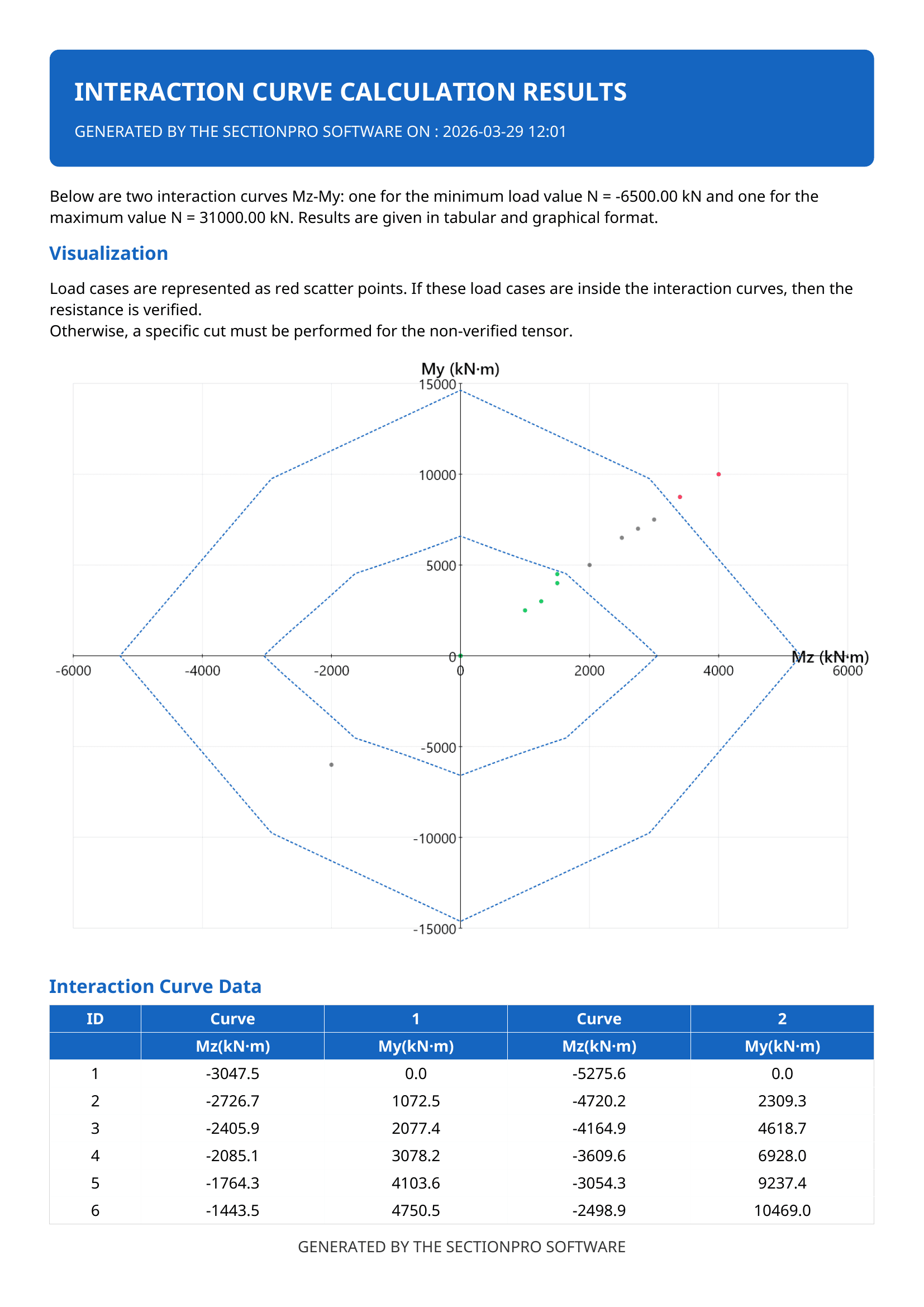
In envelope mode, SectionPro draws two curves: one for the maximum value of the fixed component across all load combinations, and one for the minimum value. This allows validating multiple load cases with different fixed-component values in a single figure, without generating a separate curve for each value. The fixed-component values of all load combinations must lie within the resistance domain of the section. In this mode, a third color is used: green means inside both curves (safe at both extremes), red means outside both curves (fails at both extremes), grey means between the two curves (uncertain, requires a more precise check by fixing the component at the load's actual value, using the 3D interaction surface, or running the internal equilibrium solver).
Computed results
Interaction curve
Visual verification
Exports
Octagonal section (Eurocode 2)
Input data
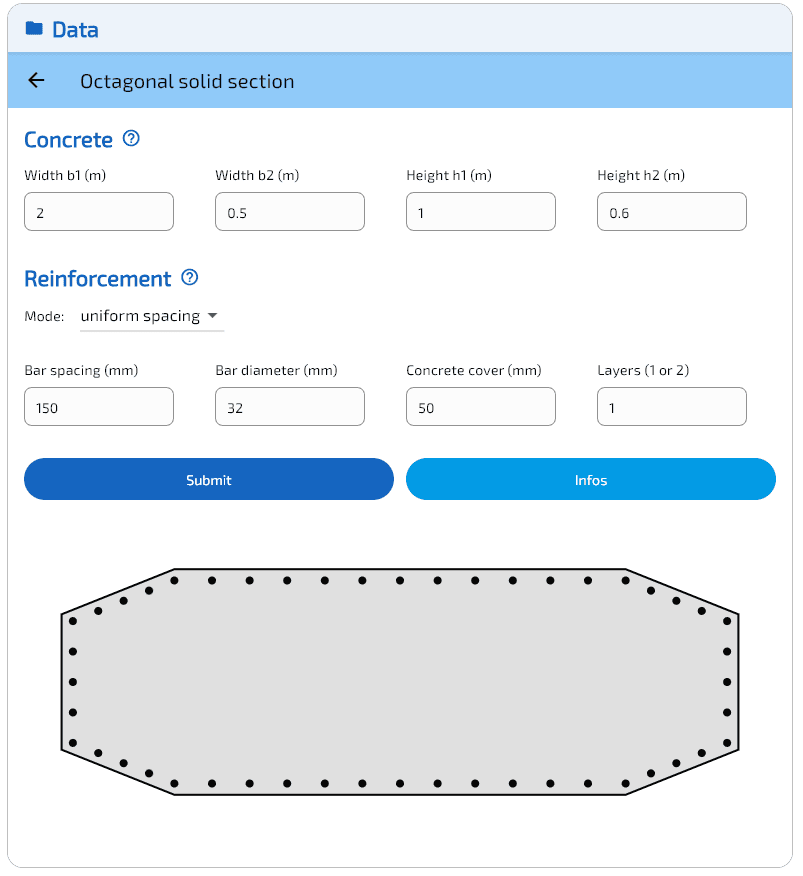
- Concrete — Octagonal cross section, m, m, m, m.
- Reinforcement — 48 bars, uniform spacing 150 mm, diameter mm, cover 50 mm.
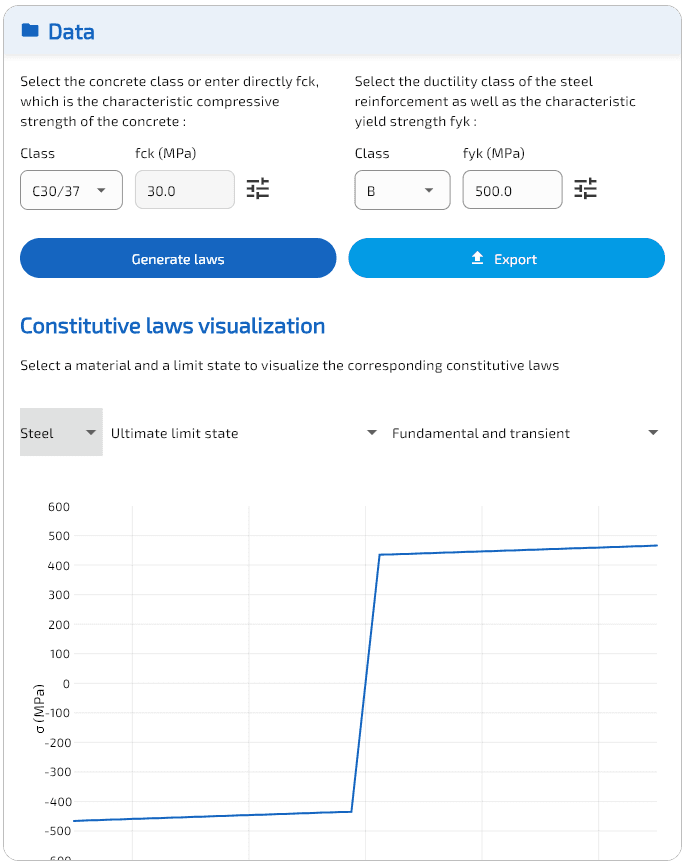
- Material laws (EC2) — Concrete C30/37: MPa, Steel B500B: MPa.
Interaction curves
The first curve shows the biaxial bending capacity at zero axial force () under the serviceability limit state (SLS-C), while the second shows the classical axial force-bending interaction at zero out-of-plane moment () under the ultimate limit state (ULS-F).
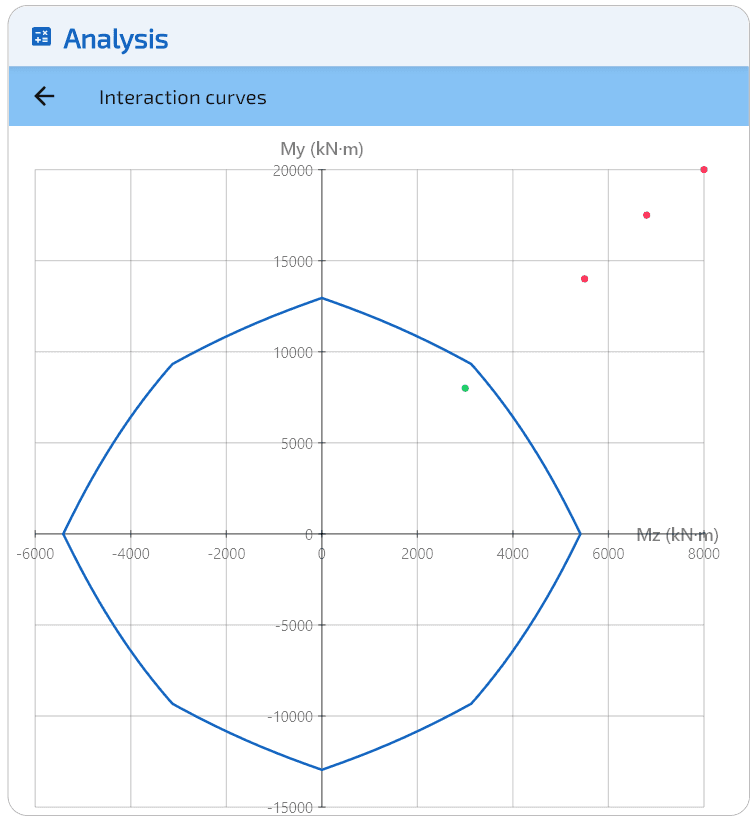
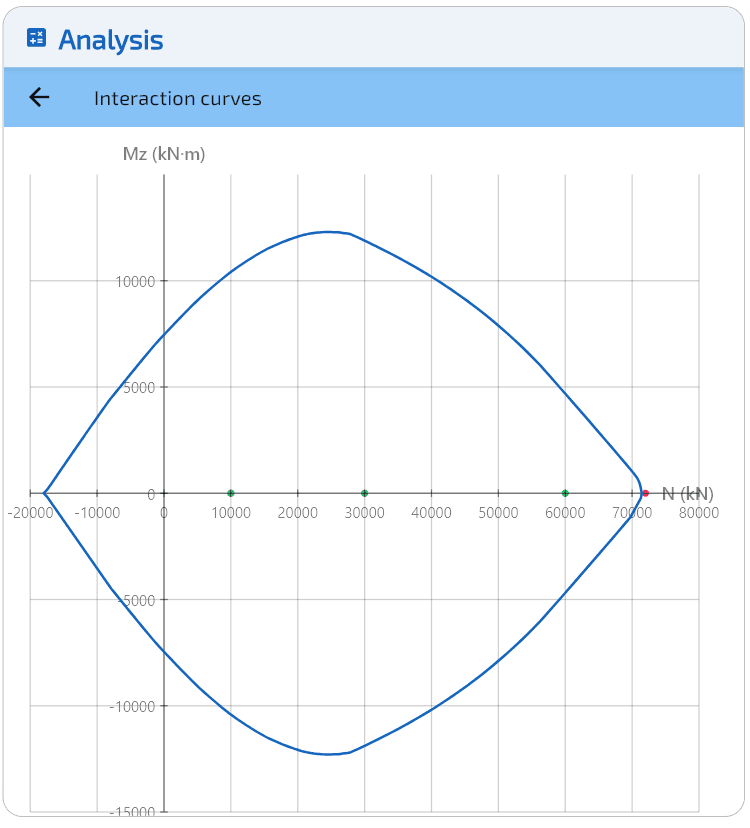
The 30 load combinations are the same as in the distances article (15 ULS-F, 15 SLS-C). All green loads had in the 3D analysis, and all red loads had , the 2D curves are fully consistent with the 3D distance results.
Envelope mode
The envelope mode requires that all load combinations have their fixed-component value within the resistance domain. Some of the original 30 loads exceed the section capacity, so a reduced set of loads is used here. Each envelope consists of two curves: one at the minimum value and one at the maximum value of the fixed component across all loads.
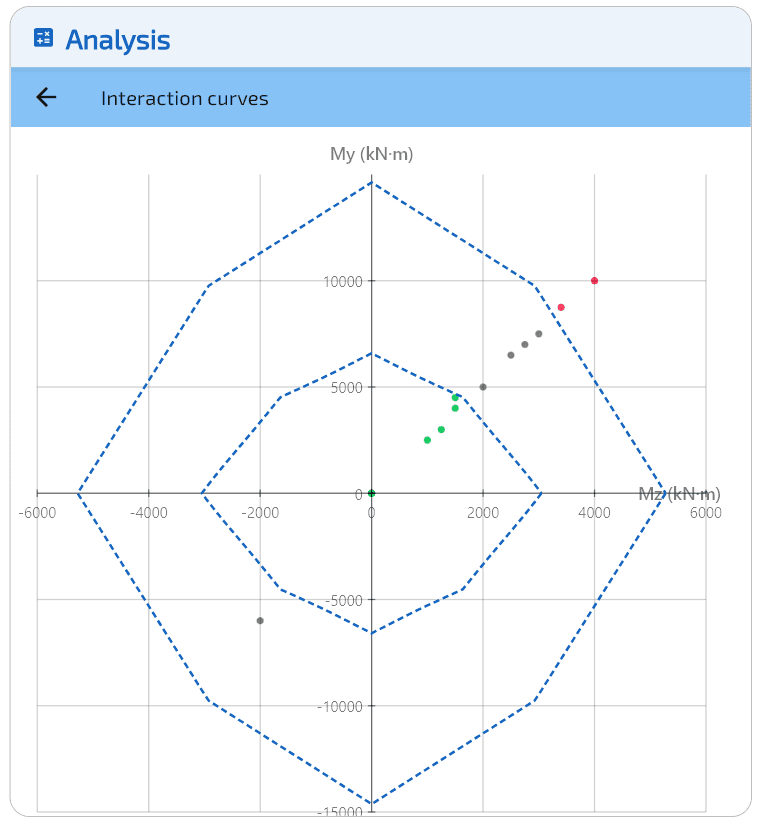
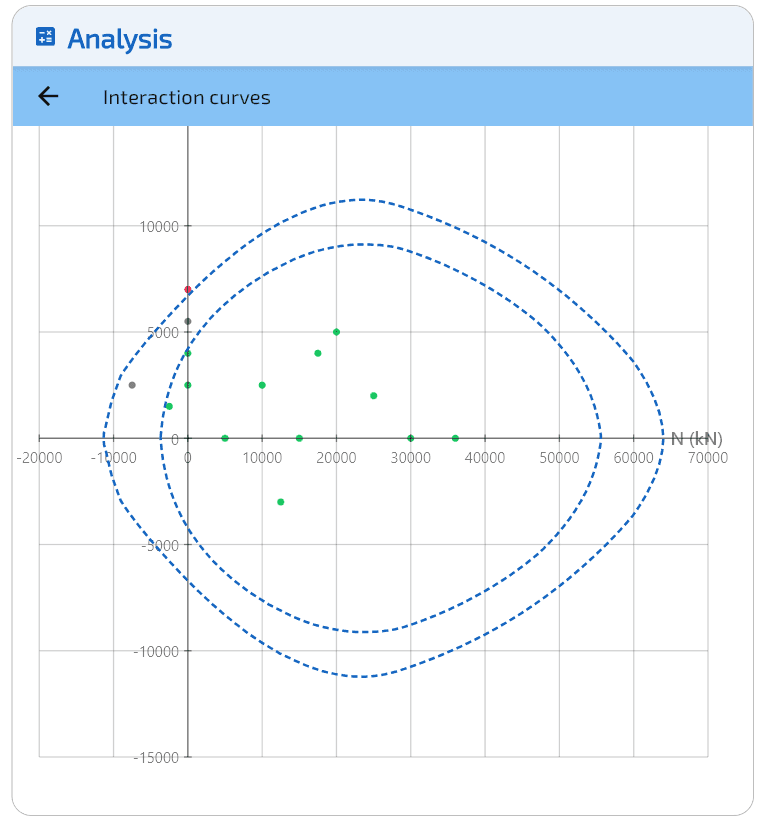
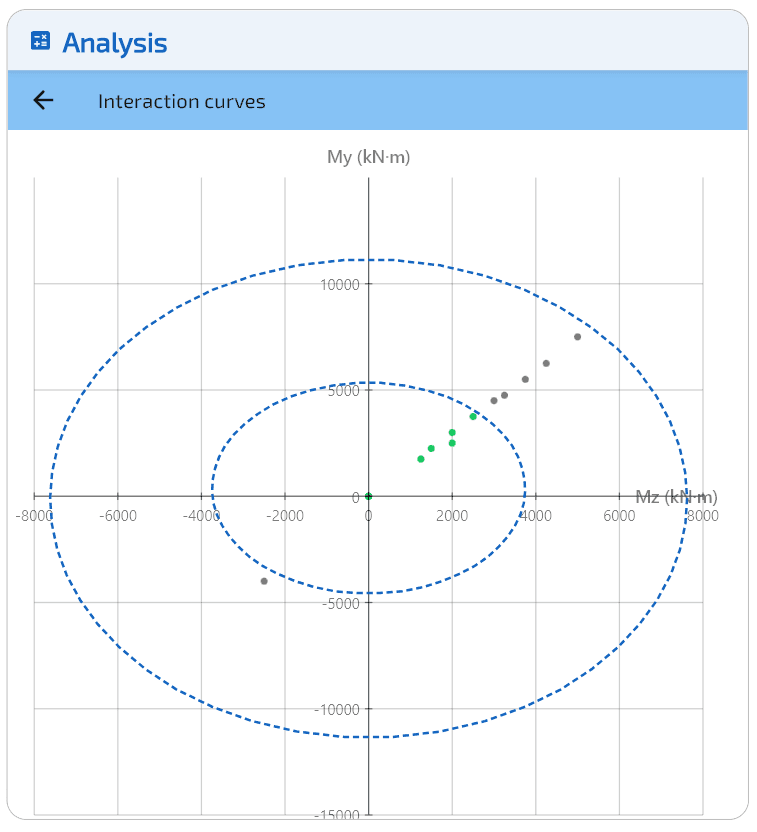
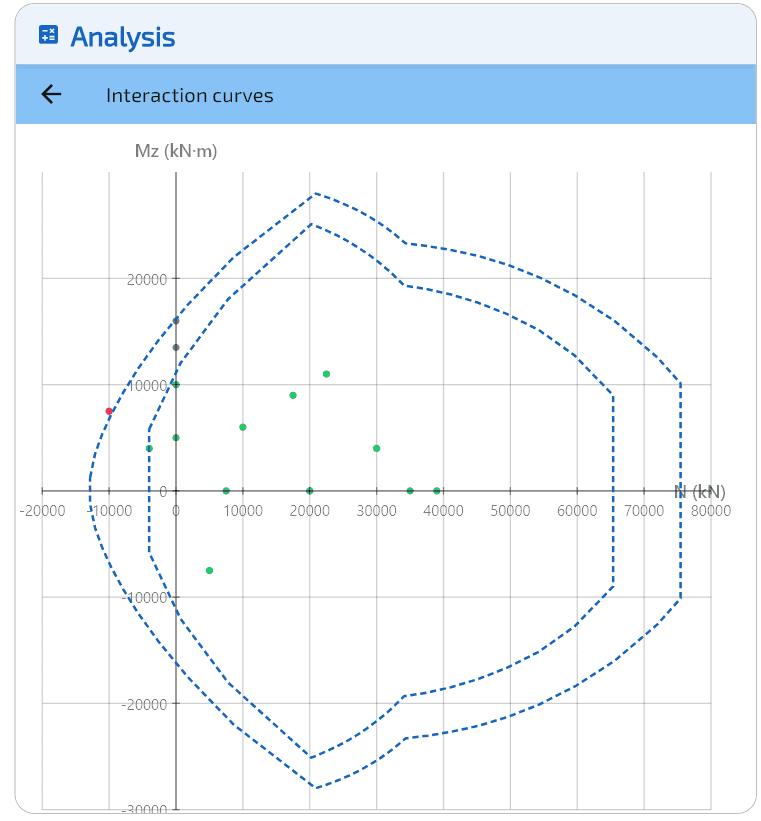
The green markers fall inside both bounding curves: they are within the resistance domain at both the minimum and maximum values of the fixed component, and are therefore verified safe. The red markers fall outside both curves, meaning they exceed the section capacity at both extremes. The grey markers lie between the two curves: they are inside the resistance domain at one extreme but not the other. Their status is ambiguous and the engineer should verify them using the fixed-component mode, the 3D interaction surface, or the internal equilibrium solver.
Elliptical section (ACI 318)
Input data
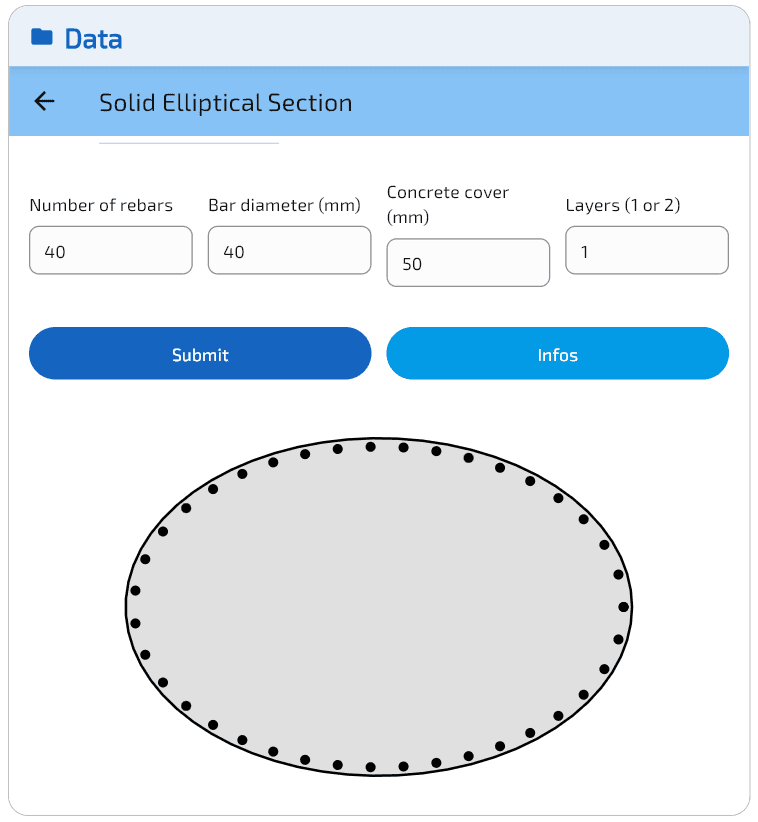
- Concrete — Elliptical cross section, width m, height m.
- Reinforcement — 40 bars along the perimeter, diameter mm, cover 50 mm.
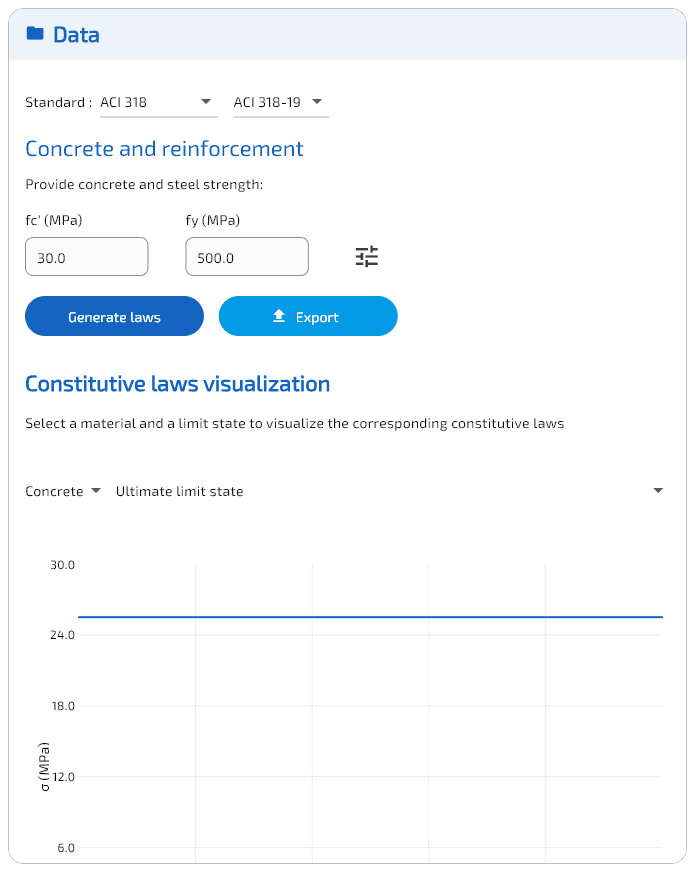
- Material laws (ACI 318) — Concrete: MPa, Steel: MPa.
Interaction curves
The first curve shows the biaxial bending capacity at (serviceability), while the second shows the axial force-bending interaction at (ultimate). The Whitney stress block and -factors are applied natively to the ultimate curve.
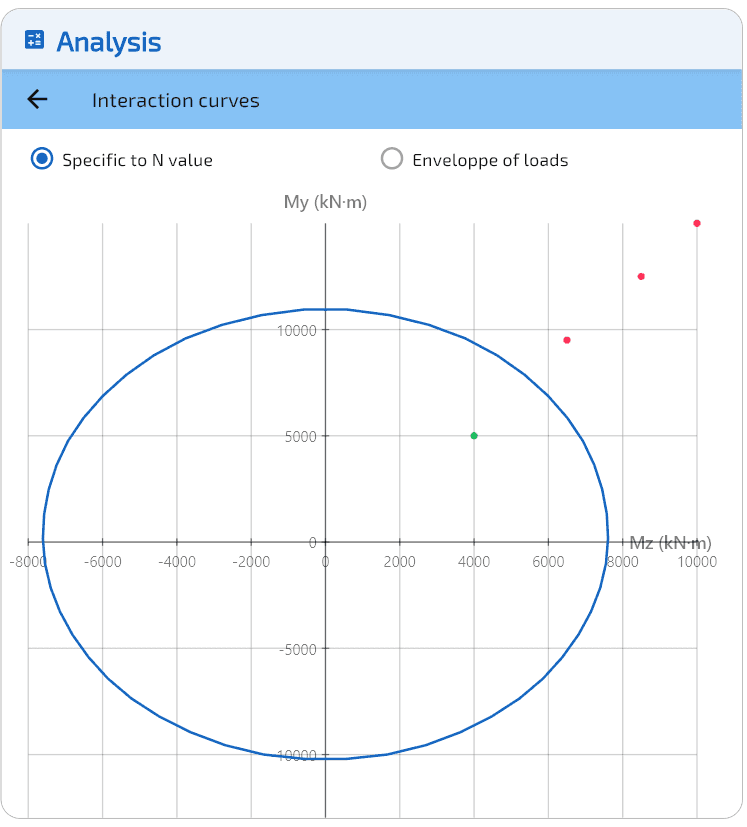
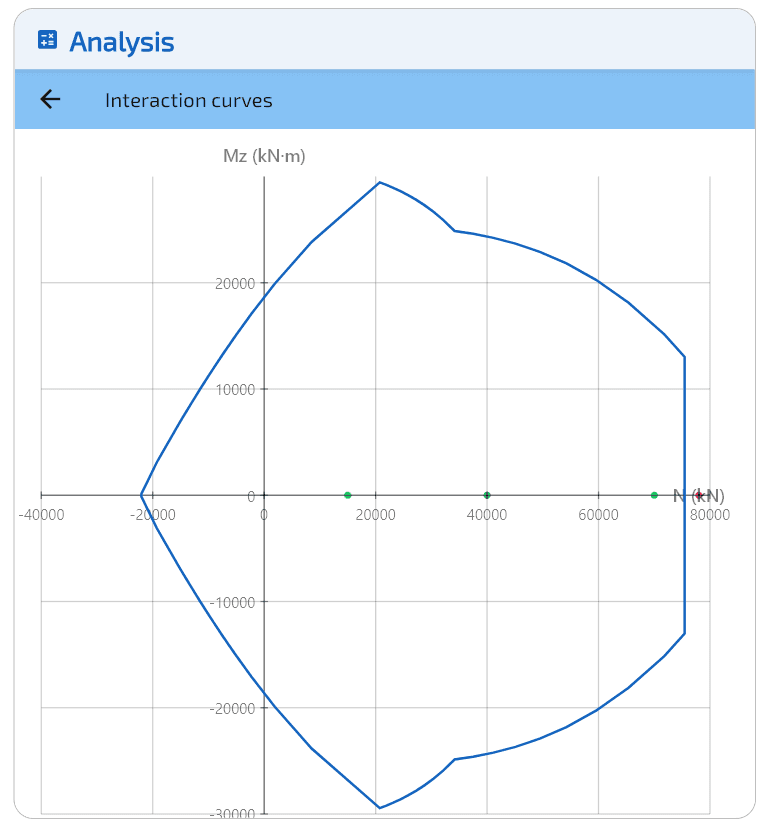
The ultimate curve shows the effects of the ACI 318 Whitney block formulation. The maximum compressive force is capped at , the flat vertical boundary on the right side of the diagram. This cap reflects the code-mandated maximum axial load reduction ( for tied columns). The transition between tension-controlled () and compression-controlled () regions is visible as a change in curvature near the balanced point. The serviceability curve uses linear elastic stress-strain laws without reduction factors, resulting in a smooth symmetric shape.
Envelope mode
The same reduced load set is used. The envelope computes two curves at the minimum and maximum values of the fixed component. The same three-color classification applies.
Performance benchmark
The interaction curve computation depends on the mesh resolution selected by the user. Higher resolutions produce smoother curves at the cost of longer computation times.
| Mesh resolution | Octagonal EC2 (ms) | Elliptical ACI (ms) |
|---|---|---|
| 51 x 50 | 8.5 | 6.5 |
| 101 x 100 | 11.0 | 7.0 |
| 201 x 200 | 14.5 | 9.0 |
All computations remain under 15 ms even at the highest resolution, making the interaction curves essentially instantaneous for the engineer.
Conclusion
The 2D interaction curves provide the classical engineering diagrams that complement the 3D surface. Loads scattered on the curve show immediately which are safe and which exceed capacity, without computing numerical safety factors. The Internal/External classification from the 3D distance evaluation is fully consistent with the 2D curve position. The 2D curves for ACI 318 are computed with the Whitney block and -factors natively. The envelope mode validates multiple load cases with different fixed-component values in a single figure, using three-color classification (green/grey/red). Curves are generated in milliseconds, even at high mesh resolutions.
Export
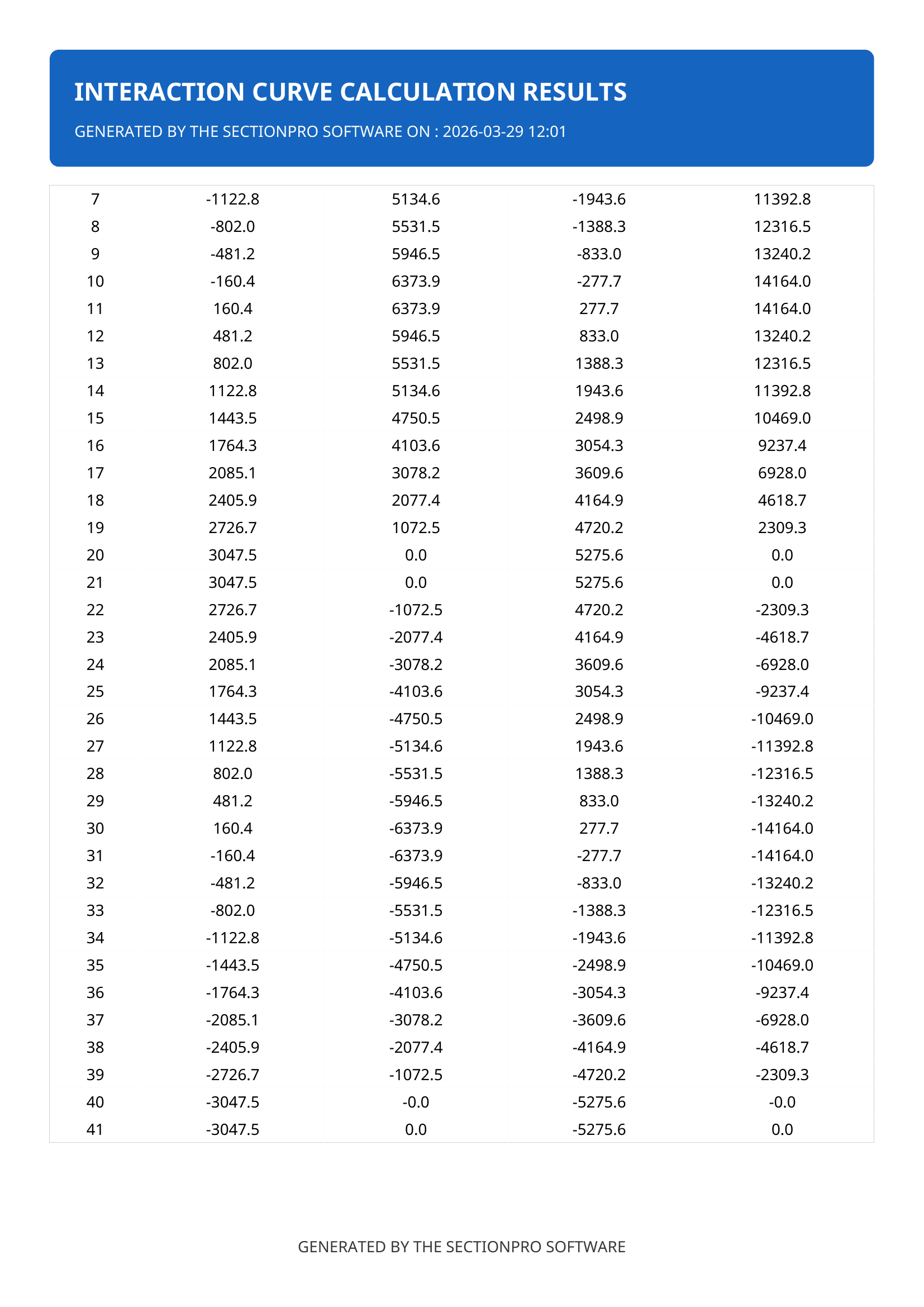
SectionPro exports the interaction curves in PDF, TXT and XLS formats. The PDF report includes the 2D curve with scattered load points and curve coordinates.